

Nursing school exams can feel overwhelming, but mastering effective test taking strategies for nursing students can transform your academic performance. Student research consistently shows that exam success depends not just on what you study, but how you approach the test itself. Whether you’re preparing for unit exams, finals, or the NCLEX, understanding proven strategies can reduce anxiety and improve your scores significantly.
This comprehensive guide walks you through everything from understanding different question formats to implementing during-the-test techniques that work. Student research reveals that nursing students who apply structured test-taking methods score 15-20% higher than those who rely solely on content knowledge. You’ll discover how to prepare effectively, manage your time during exams, eliminate wrong answers systematically, and continuously improve your performance through strategic review. Master test taking strategies for nursing students with proven techniques for exam prep, question analysis, time management, and performance review.
Understanding Nursing Exam Formats: Types of Questions You’ll Face
Before you can master test-taking strategies, you need to understand what you’re up against. Nursing exams use specialized question formats designed to assess critical thinking, clinical judgment, and priority-setting skills. Recognizing these question types and their unique characteristics will help you approach each one with confidence and the right strategy.
What Are NCLEX-Style Questions and How Do They Work
NCLEX-style questions are the gold standard in nursing education, designed to evaluate your clinical reasoning rather than simple memorization:
- Scenario-based format – Questions present realistic patient situations requiring you to apply nursing knowledge in context
- Four answer options – Typically includes one correct answer and three distractors that may seem plausible
- Higher-order thinking focus – Questions assess analysis, application, and evaluation rather than recall
- Clinical judgment measurement – Tests your ability to recognize cues, analyze information, prioritize care, and evaluate outcomes
- Next Generation NCLEX elements – May include case studies, bow-tie items, or enhanced hot spots that mirror real clinical decision-making
Understanding this format helps you shift from studying facts to practicing clinical reasoning skills.
Need Evidence-Based Research for Your Nursing Assignments?
StudentResearch.net provides deep-dive research that goes beyond basic internet searches. Our expert writers access proprietary medical databases, peer-reviewed nursing journals, and current clinical guidelines to support your papers with credible, high-quality sources. Get academic work backed by real research excellence.
Difference Between Multiple Choice and Select All That Apply (SATA) Questions
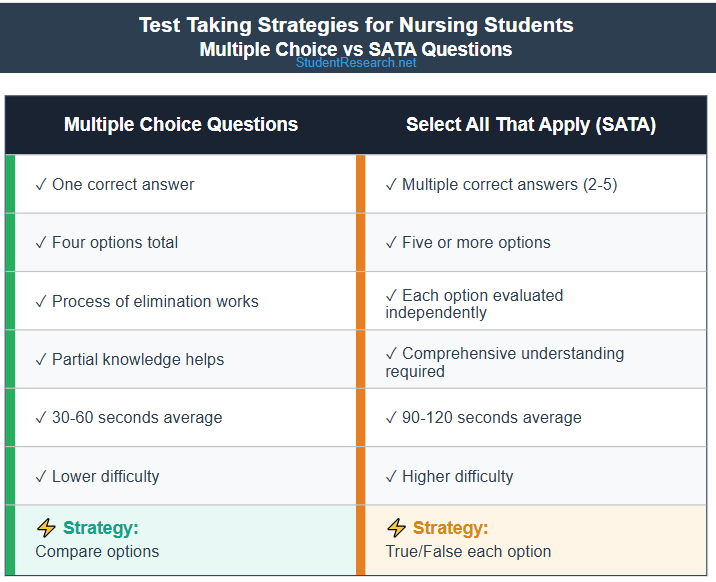
These two question types require completely different approaches and test distinct competencies:
Multiple Choice Questions:
- One correct answer among four options
- Process of elimination works effectively
- Partial knowledge can lead to correct guesses
- Faster to answer (30-60 seconds average)
Select All That Apply (SATA) Questions:
- Multiple correct answers possible (typically 2-5 options)
- All correct choices must be selected for full credit
- No partial credit awarded in most testing formats
- Requires comprehensive understanding of the topic
- Takes longer to answer carefully (90-120 seconds average)
- Higher difficulty rating but worth same points as multiple choice
Key strategy difference: SATA questions demand you evaluate each option independently as true or false, rather than comparing options against each other.
How to Answer Critical Thinking and Priority-Setting Questions
Priority-setting questions are among the most challenging because they require synthesizing multiple nursing concepts simultaneously:
- ABC framework application – Airway, Breathing, Circulation always take precedence unless the patient is stable in these areas
- Maslow’s Hierarchy integration – Physiological needs trump safety, which trumps psychosocial needs in acute situations
- “First, then, next” language recognition – Questions asking “what should the nurse do first” require strict priority ranking
- Actual vs. potential problems – Address immediate threats before preventing future complications
- Life-threatening vs. non-urgent distinction – Recognize when assessment is needed versus when immediate intervention is required
- Scope of practice considerations – Identify tasks requiring RN judgment versus those appropriate for delegation
Practice tip: When stuck between two good answers, ask yourself “Which action prevents the most harm right now?” This clinical judgment principle guides most priority questions.
How to Prepare for Nursing Exams: Pre-Test Strategies
Effective preparation is the foundation of exam success. The weeks and days leading up to your nursing exam determine not only how much you know, but how well you can retrieve and apply that knowledge under pressure. These test taking strategies for nursing students begin long before you sit down with the exam booklet.
Steps to Creating an Effective Study Schedule
A strategic study schedule prevents last-minute cramming and reduces test anxiety significantly:
- Start 2-3 weeks before major exams – This timeframe allows for spaced repetition, which improves long-term retention by 200% compared to cramming
- Block study time in 50-minute intervals – Student research shows that focused study sessions with 10-minute breaks maximize concentration and prevent burnout
- Prioritize weak content areas first – Allocate 60% of study time to challenging topics and 40% to review of stronger areas
- Schedule practice tests weekly – Simulate exam conditions to build stamina and identify knowledge gaps early
- Include review days before the exam – The final 48 hours should focus on high-yield review, not learning new material
Pro tip: Use a physical planner or digital calendar with alerts to hold yourself accountable to your study commitments.
Struggling to Turn Your Nursing Knowledge Into Top Grades?
StudentResearch.net specializes in elevating your grade profile with expertly crafted nursing papers that meet the highest academic standards. Our writers understand what instructors look for and deliver work designed to earn you the A’s you deserve. Let us help transform your hard work into outstanding results.
Best Ways to Study Nursing Content Actively
Passive reading won’t prepare you for application-based nursing exams. Active learning techniques engage multiple cognitive processes:
Concept Mapping for Pathophysiology:
- Create visual diagrams connecting disease processes, signs/symptoms, interventions, and complications
- Map medication classes to their mechanisms of action and nursing considerations
- Link lab values to underlying conditions and required nursing actions
Practice Questions with Rationales:
- Complete 30-50 practice questions daily during exam preparation
- Read rationales for both correct and incorrect answers to deepen understanding
- Focus on why wrong answers are incorrect, not just memorizing the right one
Study Groups and Peer Teaching:
- Explaining concepts to classmates reinforces your own understanding
- Discussing different perspectives on priority-setting questions broadens clinical reasoning
- Collaborative learning catches misconceptions before they appear on exams
Flashcards for Medications and Lab Values:
- Front: Drug name or lab test | Back: Key nursing considerations, normal ranges, critical values
- Review high-risk medications (anticoagulants, insulin, opioids) daily
- Quiz yourself randomly rather than in the same order to improve recall
How to Manage Test Anxiety Before Exam Day
Student research indicates that 60-70% of nursing students experience moderate to severe test anxiety, which can lower scores by 10-15 points:
- Practice relaxation techniques daily – Deep breathing, progressive muscle relaxation, or guided imagery for 10 minutes reduces physiological anxiety responses
- Reframe negative self-talk – Replace “I’m going to fail” with “I’ve prepared well and can handle challenging questions”
- Maintain physical wellness – Adequate sleep (7-8 hours), regular exercise, and proper nutrition stabilize mood and cognitive function
- Arrive early on exam day – Rushing increases cortisol levels; arriving 15 minutes early allows time to settle and center yourself
- Develop a pre-exam ritual – Consistent routines (same breakfast, same arrival time, same seat if possible) create psychological comfort
- Limit caffeine intake – While moderate caffeine improves alertness, excessive amounts increase jitteriness and anxiety
Important: If anxiety significantly impairs your performance despite these strategies, consult your school’s counseling services for additional support.
Section 2 Word Count: 297 words
How to Take Nursing Exams: During-the-Test Techniques
Once the exam begins, your preparation meets execution. Applying test taking strategies for nursing students during the actual exam can mean the difference between passing and excelling. These real-time techniques help you work through questions systematically and avoid common pitfalls.
How to Use the ABC Priority Framework and Maslow’s Hierarchy
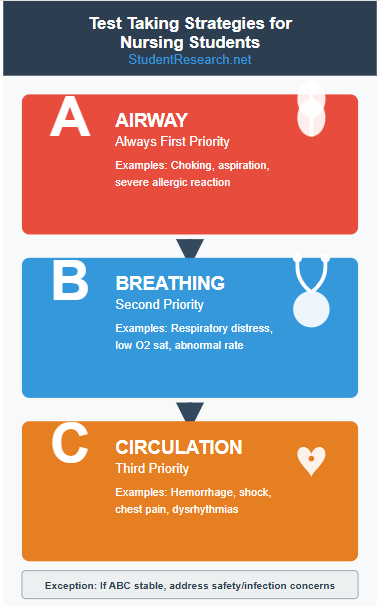
Two fundamental frameworks guide priority-setting in nursing, and they’re essential for exam success:
The ABC Priority Framework:
- Airway – Always address airway compromise first (choking, aspiration, obstruction, severe allergic reactions)
- Breathing – Respiratory distress comes second (difficulty breathing, low oxygen saturation, abnormal respiratory rate)
- Circulation – Cardiovascular issues follow (hemorrhage, shock, chest pain, dysrhythmias)
- Exceptions – If ABC is stable, move to other urgent needs like safety concerns or infection control
Maslow’s Hierarchy Application:
- Physiological needs (oxygen, fluids, nutrition, elimination) take priority over all others
- Safety needs (fall prevention, infection control, safe medication administration) come next
- Psychosocial needs (emotional support, patient teaching, discharge planning) are addressed after physical stability
Integration strategy: When a question presents multiple patient problems, mentally tag each with ABC or Maslow’s level, then select the highest priority intervention.
Overwhelmed by Pharmacology, Pathophysiology, or Advanced Practice Concepts?
StudentResearch.net simplifies complex nursing subjects with experts across 50+ challenging healthcare fields. From medication calculations to critical care protocols, our specialized writers break down difficult topics into clear, comprehensive papers that demonstrate true understanding and earn top marks.
Steps to Eliminating Wrong Answers Systematically
Process of elimination is one of the most powerful test taking strategies for nursing students, especially when you’re uncertain:
Step 1: Identify Absolute Words
- Eliminate answers containing “always,” “never,” “all,” “none,” “only,” or “every”
- Nursing practice rarely deals in absolutes; these options are usually incorrect
- Exception: Safety rules may use absolutes appropriately (e.g., “always verify patient identity”)
Step 2: Remove Duplicate or Similar Options
- If two answers say essentially the same thing using different words, both are likely wrong
- The correct answer must be distinctly different from all other options
Step 3: Eliminate Answers That Don’t Address the Question
- Reread the question stem carefully to identify what’s actually being asked
- Cross out options that answer a different question or skip necessary steps
- Watch for questions asking “first action” versus “priority teaching” versus “best response”
Step 4: Choose the Most Comprehensive Correct Answer
- When multiple answers seem correct, select the one that addresses the patient’s need most completely
- Therapeutic communication answers usually outrank tasks in psychosocial situations
- Assessment answers often precede intervention answers unless there’s immediate danger
Final check: Before selecting your answer, reread the question with your chosen option to ensure it makes logical sense.
Ways to Manage Your Time During Nursing Exams
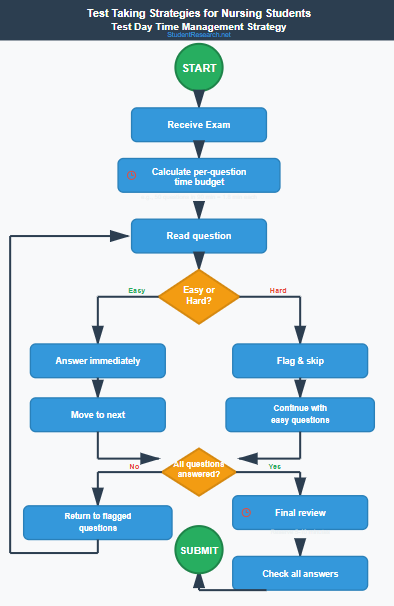
Poor time management causes preventable errors and incomplete exams. Strategic pacing ensures you can thoughtfully answer every question:
- Calculate your per-question time budget – For a 50-question exam in 90 minutes, you have 1.8 minutes (108 seconds) per question
- Answer easy questions first – Build confidence and bank extra time for difficult questions by moving quickly through straightforward items
- Flag and skip challenging questions – Don’t spend 5 minutes on one question; mark it and return after completing easier ones
- Allocate extra time for SATA questions – These require evaluating each option independently and typically need 30-45 seconds longer
- Reserve 5-10 minutes for final review – Check that all questions are answered, review flagged items, and verify you didn’t misread any questions
- Watch for time markers – Check the clock at 25%, 50%, and 75% completion to ensure you’re on pace
- Don’t change answers impulsively – Only change an answer if you misread the question or recall specific information; first instincts are usually correct
Time trap warning: Avoid getting emotionally invested in proving you can answer a difficult question. Strategic skipping is smart test-taking, not giving up.
Why Post-Exam Review Matters: Continuous Improvement Strategies
Your learning doesn’t end when you submit the exam. Post-exam analysis transforms each testing experience into a learning opportunity that strengthens future performance. Implementing these final test taking strategies for nursing students creates a cycle of continuous improvement throughout your nursing education.
How to Analyze Your Test Performance Patterns
Systematic performance analysis reveals trends that raw scores can’t show:
- Review missed questions by category – Group errors by content area (pharmacology, fundamentals, medical-surgical) to identify knowledge gaps
- Identify question type weaknesses – Track whether you miss more SATA questions, priority questions, or calculation problems
- Examine your reasoning patterns – Did you eliminate the correct answer too quickly? Second-guess yourself? Misread the question?
- Note timing issues – Determine if you rushed through sections or spent too long on specific question types
- Assess test anxiety impact – Reflect on whether anxiety affected your concentration, decision-making, or physical comfort during the exam
- Compare in-class versus standardized exams – Different testing environments may reveal performance variations worth addressing
Action step: Create a simple spreadsheet tracking exam dates, scores, content areas tested, and specific improvement goals for each exam cycle.
Steps to Building a Personalized Test-Taking Strategy
Generic advice only goes so far. Your most effective strategy combines proven techniques with insights about your individual learning style and testing patterns:
Step 1: Document What Works for You
- Keep a “test success journal” noting which preparation methods yielded the best retention
- Record which during-test techniques (elimination, ABC priority, time management) felt most natural and effective
- Identify your peak performance conditions (morning versus afternoon exams, quiet versus ambient noise)
Step 2: Address Your Specific Weaknesses
- If you consistently miss pharmacology questions, dedicate 20% more study time to medications
- If SATA questions challenge you, complete 10 additional practice SATA items daily
- If test anxiety peaks during the first 10 minutes, develop a specific calming routine to use after receiving the exam
Step 3: Track Content Areas Needing Reinforcement
- Maintain a running list of topics where you’ve missed multiple questions across different exams
- Revisit these topics using varied study methods (videos, concept maps, study groups) until mastery improves
- Connect weak content areas to clinical experiences when possible for deeper understanding
Step 4: Refine Question Type Approaches
- Analyze which types of questions consistently challenge you (priority-setting, delegation, teaching)
- Develop specific strategies for these question types based on their unique demands
- Practice these challenging formats more frequently than question types you’ve mastered
Step 5: Adjust Timing and Pacing
- If you frequently run out of time, practice with a timer during study sessions
- If you finish with excessive time remaining, slow down and use extra minutes for thorough question analysis
- Find your optimal balance between thoughtful consideration and efficient progress
Step 6: Evaluate Stress Management Effectiveness
- After each exam, rate your anxiety level from 1-10 and note which coping strategies you used
- Identify which techniques successfully reduced anxiety and which felt ineffective
- Gradually build a personalized anxiety-management toolkit that consistently works for you
Remember: Your testing strategy should evolve as you progress through nursing school. What works for fundamentals may need adjustment for advanced medical-surgical or critical care exams. Regular reflection and adaptation are key to sustained exam success.
Conclusion
Mastering test taking strategies for nursing students is an investment that pays dividends throughout your entire nursing career. From understanding question formats to managing exam anxiety, from systematic answer elimination to post-exam analysis, each strategy builds your confidence and competence. Remember that effective test-taking is a skill that improves with practice and reflection. Implement these techniques consistently, track your progress, and adjust your approach based on what works best for you. Your nursing school exams are not just assessments—they’re preparation for the critical thinking and clinical judgment you’ll use every day as a professional nurse.

