

Reframing the PhD: The Early Career Researcher Mindset
Is a PhD student an early career researcher? This question fundamentally challenges how we view doctoral education. Most Master’s students considering a PhD see it as extended schooling. However, student research during a PhD represents the beginning of a professional career. This mindset shift transforms your entire doctoral experience. The sooner you embrace this perspective, the more successful you’ll become.
The Crossroads for Future PhD Students
Standing at graduation, Master’s students face a crucial decision. The PhD feels like another degree to earn. Yet this perception limits your potential from day one.
- The crossroads moment: You’re choosing between extended education or launching a research career
- Common hesitation: Fear of “just being a student” for several more years
- Reality check: Every PhD program is actually professional training in disguise
- The stakes: Your mindset determines your success trajectory
The Misconception About PhD Students
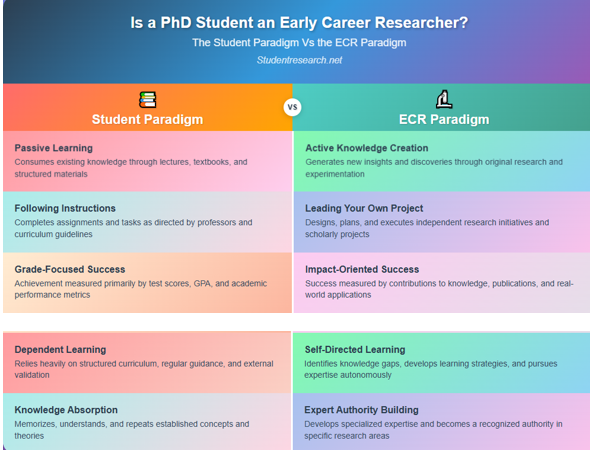
Society perpetuates the myth that PhD students are simply advanced learners. This misconception prevents you from recognizing your true value. Most people don’t understand the professional nature of doctoral work.
- The education myth: PhDs are seen as “super students” rather than researchers
- Financial perspective: Stipends are viewed as financial aid, not professional compensation
- Social perception: Friends and family expect you to “graduate” rather than “launch a career”
- Internal struggle: Students themselves often feel like imposters in professional settings
- The truth: From day one, you’re conducting original research that advances human knowledge
Step 1: Understanding the Identity Shift for PhD Students
The PhD journey represents a fundamental transformation in how you approach knowledge. You’re shifting from consuming information to creating it. This identity change happens gradually but impacts everything you do.
- From student to researcher: Stop waiting for assignments; start identifying problems to solve
- Knowledge creation mindset: Your thesis contributes new understanding to your field
- Professional apprenticeship: You’re learning to become an independent researcher
- Expert development: By graduation, you’ll know more about your topic than most people alive
- Leadership preparation: PhD programs train future thought leaders and decision-makers
Ultimately, the answer to the question, “Is a PhD student an early career researcher?” is not dependent on what one feels but should be a resounding yes. It’s a rewarding journey where you become a leader in your field. So, are you ready to embrace your ECR identity?
Struggling with assignments? Studentresearch.net connects you with Ph.D.-qualified expert writers who deliver 100% plagiarism-free, custom research papers with perfect APA, MLA formatting. Boost your grades today!
The ECR Framework: What PhD Students Master on Their Journey
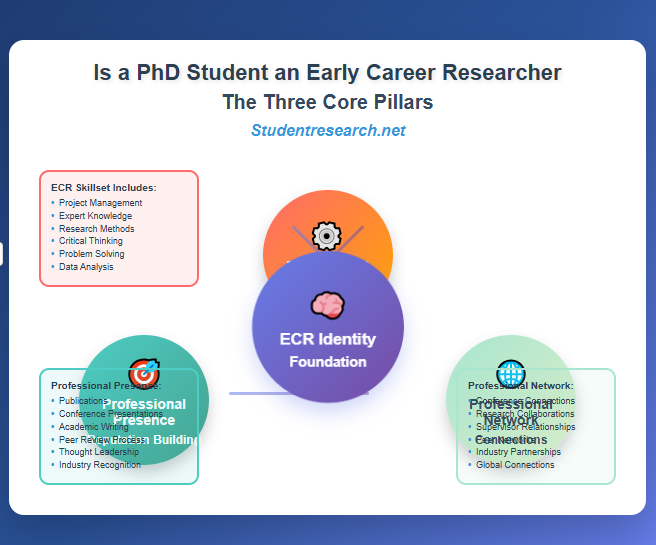
Understanding your identity as an early career researcher requires recognizing the comprehensive skill development that occurs during your PhD. This transformation builds on three fundamental pillars that distinguish researchers from students. Your student research experience becomes the foundation for professional expertise. Each year strengthens your capabilities across multiple domains. The ECR framework provides structure for this professional development.
Step 2: Mastering the ECR Skillset as a PhD Student
Your PhD develops a unique combination of technical and professional skills. These capabilities distinguish you from other professionals in the job market. The depth and breadth of this skillset creates tremendous career flexibility.
- Project management mastery: Your thesis is a multi-year project requiring planning, resource allocation, and deadline management
- World-class expertise: Your research makes you the leading authority on your specific topic
- Research methodology: You master experimental design, data collection, and analysis techniques
- Critical thinking development: You learn to evaluate evidence, identify flaws in reasoning, and construct logical arguments
- Problem-solving abilities: You tackle complex, ambiguous problems with no predetermined solutions
- Technical writing skills: You communicate complex ideas clearly to both expert and general audiences
- Data analysis expertise: You work with large datasets, statistical software, and interpretation methods
Transform your academic performance with Studentresearch.net’s Master’s and Ph.D. specialists. We craft original, high-quality papers with zero plagiarism, proper referencing, and flawless formatting tailored to your needs.
Step 3: Building a Professional Presence as an Early Career Researcher
Your professional reputation begins developing during your PhD program. Publications and presentations establish your credibility in the research community. These activities transform you from a student into a recognized expert.
- Publication strategy: Research papers aren’t requirements; they’re your professional portfolio
- Peer review process: You learn to give and receive criticism, improving your work’s quality
- Conference presentations: Speaking at conferences positions you as a thought leader
- Academic networking: You build relationships with established researchers in your field
- Communication skills: You translate complex research for diverse audiences
- Professional visibility: Your work becomes known beyond your immediate university
- Industry recognition: External validation of your expertise through citations and invitations
Get the grades you deserve! At Studentresearch.net, subject-matter experts with advanced degrees write custom, plagiarism-free assignments. Perfect Harvard, Chicago, MLA formatting included. Your academic success starts here.
Step 4: Cultivating a Professional Network as a PhD Student
A PhD is never a solitary journey despite common perceptions. You’re joining a global community of researchers working on related problems. Your network becomes one of your most valuable professional assets.
- Conference connections: Academic meetings provide opportunities to meet potential collaborators
- Workshop participation: Specialized training events create intimate networking opportunities
- Inter-lab collaborations: Working with other research groups expands your skill set
- Supervisor relationships: Your advisor opens doors to their professional network
- Peer relationships: Fellow PhD students become lifelong professional contacts
- Industry partnerships: Many programs include opportunities to work with external organizations
- International connections: Research is global, connecting you with scholars worldwide
Activating Your ECR Identity: How PhD Students Can Get a Head Start
Recognizing your potential as an early career researcher is just the beginning. The previous sections established the framework for understanding your professional development. Now, practical action steps will accelerate your growth trajectory. Student research opportunities exist even before starting your PhD program. Proactive behaviors distinguish successful researchers from their peers.
Step 5: Gaining a Competitive Advantage as an Early Career Researcher
Starting your research career early provides significant advantages over traditional approaches. Master’s students can begin building their ECR identity immediately. This head start compounds throughout your doctoral program.
- Early professional development: Begin thinking like a researcher while completing your Master’s degree
- Competitive positioning: Stand out in PhD applications by demonstrating research maturity
- Accelerated timeline: Enter your program with momentum rather than starting from zero
- Confidence building: Develop professional skills before the pressure of doctoral requirements
Before You Apply: The Mindset of Future PhD Students
Preparation for your PhD should begin months before applications are due. Research potential supervisors and their recent publications. Identify the conferences where your field’s leaders present their work.
- Supervisor research: Read recent papers from potential advisors to understand their current interests
- Conference identification: Find the top 2-3 conferences in your field and explore their recent programs
- Literature familiarity: Become conversant with major debates and recent developments in your area
- Professional communication: Practice reaching out to researchers for informational interviews
- Research proposal development: Draft preliminary ideas for your doctoral research
- Skill assessment: Identify technical skills you need to develop before starting your program
During Your PhD: The ECR Milestones
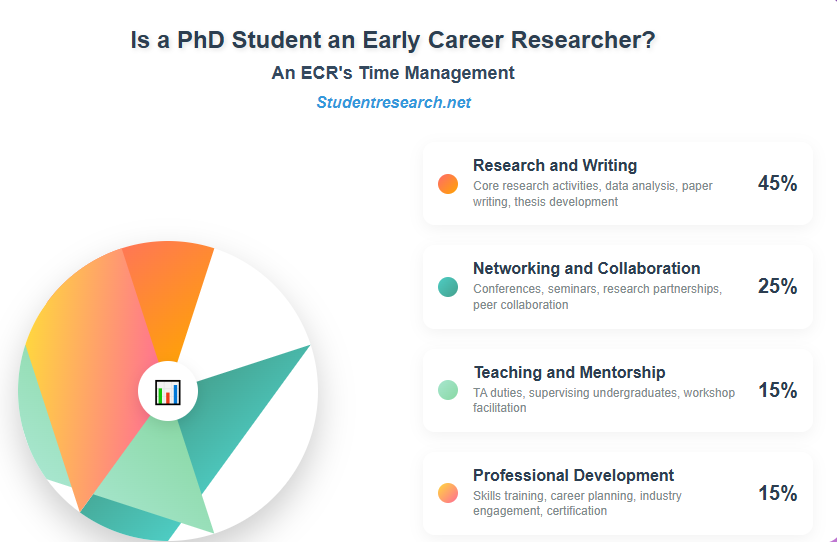
Your doctoral program should follow a strategic timeline focused on professional development. Each year builds upon previous achievements while introducing new challenges. This progression maximizes your career preparation.
Year 1: Foundation Building
- Establish strong relationships with your supervisor and committee members
- Master fundamental research methods and techniques in your field
- Begin reading widely to identify gaps in current knowledge
- Develop basic professional skills like time management and project planning
Year 2: Research Design and Execution
- Design and begin conducting your original research project
- Start attending conferences to understand your field’s professional culture
- Develop expertise in specialized techniques required for your research
- Begin building relationships with researchers outside your immediate program
Years 3 & 4: Professional Emergence
- Focus intensively on writing for publication in peer-reviewed journals
- Present your work at multiple conferences to build your professional reputation
- Expand your professional network through collaborations and partnerships
- Begin considering post-doctoral opportunities and career directions
The Ultimate Payoff: The Career Advantage of PhD Students as ECRs
The transformation from student to early career researcher creates unprecedented opportunities across multiple sectors. Your previous training as a researcher opens doors that remain closed to other professionals. Student research experience becomes the foundation for diverse career paths. This comprehensive skill development provides flexibility in an uncertain job market. So, is a PhD student an early career researcher? Absolutely. It’s the journey where you stop being a consumer of knowledge and become a true pioneer. Now is the time to begin your research career.
The Career Passport for Early Career Researchers
Your PhD serves as a passport to opportunities across academia, industry, and entrepreneurship. The skills you develop transcend traditional academic boundaries. Multiple career paths become available to trained researchers.
- Industry leadership: Companies value PhD-trained professionals for their analytical and problem-solving skills
- Government positions: Policy roles require individuals who can evaluate evidence and communicate complex issues
- Entrepreneurial ventures: Many successful startups are founded by PhD-trained individuals
- Consulting opportunities: Organizations pay premium rates for expert analytical capabilities
- Academic careers: Traditional university positions remain a viable and rewarding option
- Non-profit sector: Research organizations and think tanks seek PhD-trained professionals
Expert academic writers at Studentresearch.net with Master’s/Ph.D. qualifications guarantee original, well-researched papers. Complete plagiarism reports provided. Proper citation styles ensured. Elevate your performance instantly!
A Foundation of Excellence for PhD Students
Regardless of your final career destination, ECR training provides universally valuable capabilities. Problem-solving skills transfer across industries and sectors. Critical thinking abilities serve you throughout your professional life.
- Analytical mindset: You approach complex problems systematically and objectively
- Communication expertise: You translate technical information for diverse audiences
- Project management: You handle long-term, complex initiatives from conception to completion
- Leadership development: You guide teams and influence decision-making processes
- Adaptability: You learn new skills quickly and adjust to changing circumstances
- Global perspective: Your research connects you to international networks and opportunities
A Final Push for Aspiring ECRs
The research career offers unparalleled intellectual freedom and societal impact. Your work contributes to human understanding and solves real-world problems. The challenge is significant but so are the rewards.
Is a PhD student an early career researcher? Master’s students, learn how to reframe your PhD as a career path, not just a degree. Uncover the 5 essential skills for success: expert knowledge development, professional communication, network building, project management, and critical thinking. These capabilities position you for success across multiple career paths.
- Embrace the challenge: Research careers offer intellectual stimulation unavailable in other professions
- Accept responsibility: Your work influences future generations of scholars and practitioners
- Take action now: Begin building your ECR identity before you even start your doctoral program
- Think long-term: Your PhD is the beginning of a lifelong career in knowledge creation
- Stay committed: The journey is demanding but leads to extraordinary professional opportunities

