

Nursing Programs for International Students: 17 Proven Steps to Your Ultimate Global Healthcare Career
Pursuing a medical education abroad is a transformative journey that blends rigorous academic standards with diverse clinical exposure. Nursing programs for international students serve as the primary gateway for aspiring healers to access world-class facilities and high-demand job markets. By choosing the right pathway, you are not just earning a degree; you are securing a future in a stable, respected, and globally essential profession.
Understanding the Landscape of Global Nursing Education
Navigating the complexities of international education requires a clear understanding of accreditation and regional demands. Most nursing programs for international students are designed to align with the NCLEX-RN standards to ensure seamless licensure. This section explores why the current global nursing shortage has made this the most opportune time to start your journey.
Strategic Benefits of Studying Nursing Abroad
- Access to Advanced Simulation Labs: Gain hands-on experience with high-fidelity mannequins.
- Diverse Clinical Rotations: Work in various settings from urban trauma centers to rural clinics.
- Pathway to Permanent Residency: Many countries offer “Green Card” or work visa sponsorship for nurses.
- High Earning Potential: US and UK nursing salaries consistently outpace global averages.
Essential Requirements for International Applicants
Admission into competitive nursing programs for international students hinges on meeting specific academic and linguistic benchmarks. Universities prioritize candidates who demonstrate both scientific aptitude and the communication skills necessary for patient safety. Reviewing these criteria early ensures you have ample time to gather documentation and sit for required exams.
Academic and Language Proficiency Benchmarks
- English Language Testing (IELTS/TOEFL):
- H4: IELTS Requirements: Most Tier-1 universities require a minimum band of 7.0.
- H4: TOEFL iBT: A score of 84 or higher is typically standard for clinical placement eligibility.
- Prerequisite Coursework:
- H4: Anatomy and Physiology: Essential foundation for all clinical nursing modules.
- H4: Microbiology: Critical for understanding infection control protocols.
- Transcript Evaluation: Services like WES are often needed to verify international credits.
Strategic Selection of Degrees and Specializations
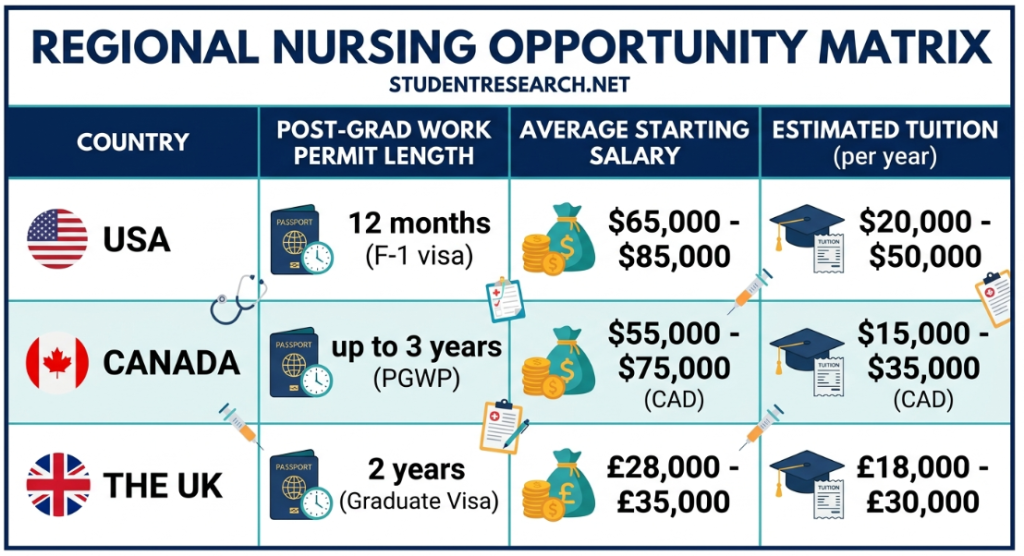
Choosing between an ADN, BSN, or Accelerated program depends on your previous background and long-term career goals. Nursing programs for international students vary in length, costing, and the depth of research opportunities provided to the cohort. Student research initiatives within these programs often allow students to contribute to global health policy while still in school.
Comparison of Nursing Degree Pathways
| Degree Type | Duration | Best For… | Career Outcome |
| ADN (Associate) | 2 Years | Fast entry to the workforce | Registered Nurse (RN) |
| BSN (Bachelors) | 4 Years | Leadership and Specialized roles | RN + Management potential |
| ABSN (Accelerated) | 12-18 Months | Career changers with a prior degree | Rapid RN Licensure |
| MSN (Masters) | 2 Years | Advanced Practice (NP, CRNA) | Specialized Clinician |
Are you struggling with complex nursing case studies? Let the specialists at StudentResearch.net handle the heavy lifting. Our expert writers deliver high-quality, plagiarism-free academic papers tailored to global medical standards. Boost your grades and save time today!
Financing Your Education: Scholarships and Financial Aid
The cost of tuition is often the biggest hurdle for those looking at nursing programs for international students in high-income countries. However, numerous institutional and private funding sources exist specifically to support the diversification of the healthcare workforce. Planning your budget involves looking beyond tuition to include living expenses and professional insurance.
Funding Opportunities for Global Students
- Institutional Merit Scholarships: Based on high GPA or entrance exam scores.
- Government-Sponsored Grants: Programs like Fulbright or Commonwealth scholarships.
- Private Healthcare Endowments: Organizations seeking to fund nurses from specific regions.
- Work-Study Programs: Opportunities to work on campus to offset personal costs.
Navigating the Visa and Clinical Placement Process
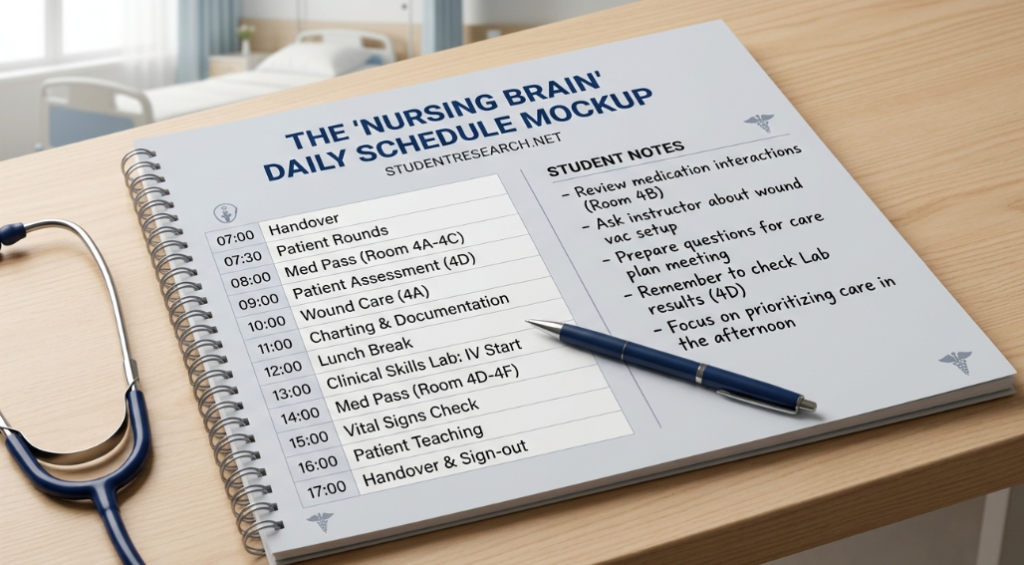
Obtaining a student visa (such as the F-1 in the US) is a multi-step process that requires proof of funding and intent to study. Nursing programs for international students must be SEVP-certified to issue the necessary paperwork for legal residency. This section outlines the transition from the classroom to the hospital floor during your clinical rotations.
Critical Steps for Legal Compliance
- Form I-20 Issuance: The foundation of your student visa application.
- CPT (Curricular Practical Training):
- H4: Clinical Hours: Allows you to work in hospitals as part of your degree.
- H4: Authorized Internships: Essential for gaining localized experience.
- OPT (Optional Practical Training): Provides a 12-month window to work post-graduation.
The 17 Proven Steps to Your Nursing Career
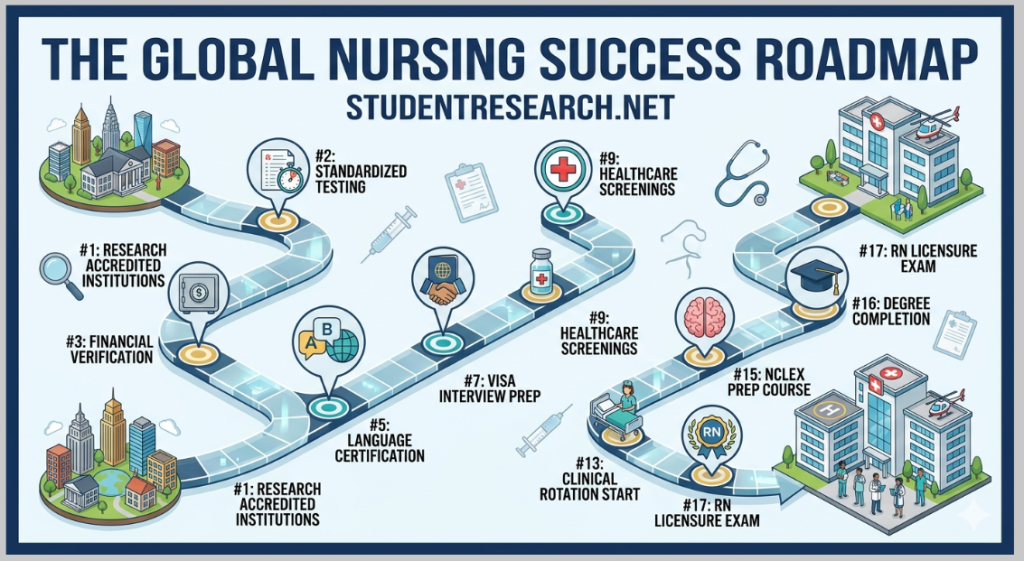
Success in nursing programs for international students is achieved through a systematic approach to both study and professional networking. Following a sequence ensures you do not miss deadlines for exams or licensing applications. Below are the specific milestones you must hit to transform from a student to a licensed professional.
The Ultimate Success Roadmap
- #1 Research Accredited Institutions: Verify the program is recognized by the state board.
- #2 Standardized Testing: Take the SAT, ACT, or TEAS exam as required.
- #3 Financial Verification: Secure funds and obtain bank statements for the visa interview.
- #4 Transcript Evaluation: Submit your high school or college documents for translation.
- #5 Language Certification: Clear the IELTS or TOEFL hurdles.
- #6 Application Submission: Apply to at least 3-5 different nursing schools.
- #7 Visa Interview Prep: Practice articulating your goals for the consulate.
- #8 Housing Coordination: Secure on-campus or vetted off-campus living.
- #9 Healthcare Screenings: Complete all required vaccinations and physical exams.
- #10 First Semester Orientation: Engage with international student advisors immediately.
- #11 Clinical Gear Acquisition: Purchase your stethoscope, scrubs, and medical kits.
- #12 Anatomy Intensive Study: Build the foundation of your medical knowledge.
- #13 Clinical Rotation Start: Begin your hands-on training in local hospitals.
- #14 Mid-Program Assessment: Ensure your student research projects are on track.
- #15 NCLEX Prep Course: Enroll in a review program 6 months before graduation.
- #16 Degree Completion: Graduate from your accredited nursing program.
- #17 RN Licensure Exam: Pass the NCLEX and apply for your professional license.
Overcoming Common Challenges in International Nursing
Cultural adjustment and the fast-paced nature of medical terminology can be daunting for many newcomers. Nursing programs for international students often provide peer tutoring and mentorship to bridge these gaps. Recognizing that these hurdles are temporary will help you maintain the focus needed for academic excellence.
Strategies for Academic and Cultural Mastery
- Peer Support Groups: Join nursing student associations for networking.
- Medical Terminology Workshops: Focus on shorthand and hospital-specific jargon.
- Stress Management: Utilize campus mental health resources during exam weeks.
- Mentorship Programs: Connect with senior international students who have succeeded.
Post-Graduation Opportunities and Career Growth
The journey does not end with a diploma; it expands into specialized fields like ICU, Pediatrics, or Oncology. Graduates of nursing programs for international students are highly sought after by recruiters due to their resilience and bilingual capabilities. Engaging in student research throughout your tenure can also lead to teaching or policy-making positions.
High-Growth Specialized Nursing Roles
- Travel Nursing: High-pay roles that allow you to work in different regions.
- Nurse Practitioner (NP): Requires further study but offers prescriptive authority.
- Informatics Nurse: Combines healthcare knowledge with data technology.
- Nurse Educator: Training the next generation of healthcare workers.
Conclusion: Launching Your Global Healthcare Legacy
Selecting the right educational path is the most significant decision you will make for your professional life. Nursing programs for international students offer a clear path to US licensure. Secure your future with top clinical training and visa support. By committing to this path, you are joining a noble profession dedicated to the service of humanity.
Final Steps for Your Application
- Review Your Checklist: Ensure all 17 steps are accounted for in your timeline.
- Contact Admissions: Reach out to international coordinators for specific queries.
- Begin Your Journey: The best time to apply was yesterday; the second best time is today
Nursing programs for international students offer a clear path to US licensure. Secure your future with top clinical training and visa support.
Need a flawlessly researched clinical nursing project? StudentResearch.net provides premium assistance for international nursing students facing tight deadlines. Don’t let stress ruin your GPA; simply click here to order for specific academic writing services from our elite team!

