

Meta Description: Master your career with Smart goals for nursing students examples. This guide offers 28 tips for academic and clinical excellence. Start today!
Navigating the Rigors of Nursing Education
The journey through nursing school is often described as a marathon run at a sprinter’s pace, where the stakes are as high as the patient volumes. To survive and thrive, you need more than just a stethoscope and a caffeine habit; you need a precise roadmap for your professional development. Utilizing smart goals for nursing students examples provides that essential framework, transforming vague ambitions into actionable milestones that lead directly to the bedside.
Understanding the SMART Framework in a Healthcare Context
Before diving into specific applications, it is vital to understand why the SMART acronym is the gold standard for healthcare professionals. This methodology ensures that every ounce of energy you expend during your student research and clinical rotations is directed toward a measurable outcome. By refining your objectives, you move from “trying your best” to achieving clinical mastery through structured planning.
Breaking Down the SMART Acronym
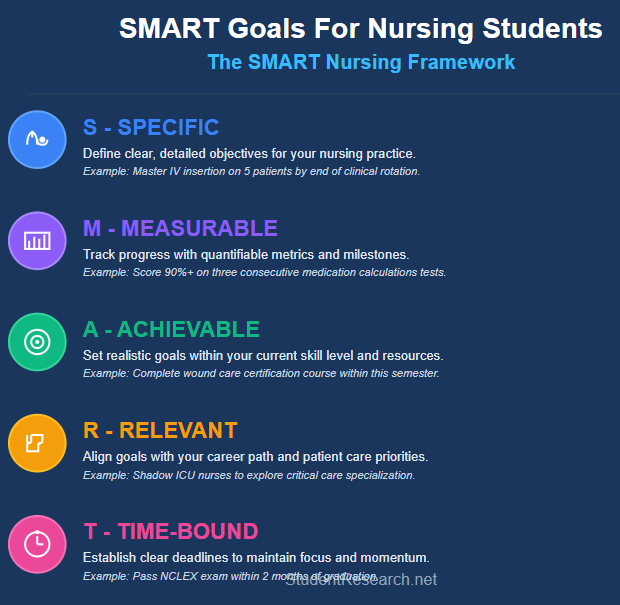
- Specific: Clearly define the clinical skill or academic grade you wish to achieve.
- Measurable: Identify the metrics, such as a percentage or a specific number of successful IV starts.
- Achievable: Ensure the goal is realistic given your current semester and resources.
- Relevant: Align the goal with your ultimate objective of becoming a Registered Nurse (RN).
- Time-bound: Set a hard deadline, such as the end of a clinical rotation or a finals week.
The Power of Specificity in Clinical Settings
- Precision: Avoiding broad statements like “be a better nurse.”
- Focus: Targeting specific weaknesses identified in your mid-term evaluations.
- Clarity: Creating a mental image of what success looks like in a high-pressure environment.
Academic Excellence: 28 Smart Goals for Nursing Students Examples
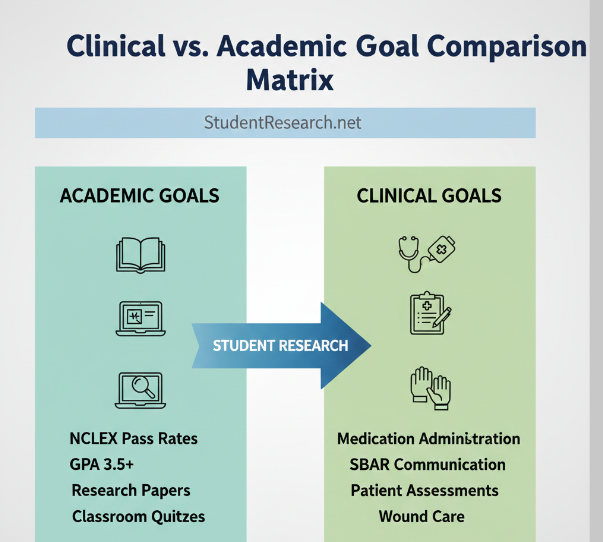
Maintaining a high GPA is not just about passing tests; it’s about retaining life-saving information that you will use for decades. The following smart goals for nursing students examples are designed to help you conquer the heavy reading loads and complex pharmacology exams that define the first two years of your program. Through diligent student research and study habits, these goals ensure you are prepared for the NCLEX long before graduation day.
Classroom and Theory Milestones
- Goal I: “I will increase my Pharmacology quiz average from 82% to 90% by the end of the semester by attending two extra tutoring sessions per week.”
- Goal II: “I will complete 50 practice NCLEX questions every day for the next 30 days to improve my test-taking stamina.”
- Goal III: “I will organize a weekly study group for Pathophysiology, ensuring we cover three chapters per session.”
Mastering Standardized Testing
- Strategy: Utilize active recall and spaced repetition.
- Tooling: Incorporate digital flashcards like Anki for drug classifications.
- Evaluation: Take a baseline practice exam to track incremental progress.
The 12-Week SMART Nursing Roadmap
This schedule integrates student research and clinical application to ensure a balanced trajectory toward graduation.
- Weeks 1–3: Foundation & Pharmacological Fluency
- Goal i: I will memorize the top 50 most prescribed medications and their contraindications by the end of week 3.
- Goal ii: I will complete 100 practice questions on drug calculations with 100% accuracy.
- Weeks 4–6: Clinical Skills Synthesis
- Goal iii: I will perform at least four sterile dressing changes under instructor supervision during clinical rotations.
- Goal iv: I will conduct three comprehensive student research reviews on patient-centered care models to improve my bedside manner.
- Weeks 7–9: Advanced Assessment & Pathophysiology
- Goal v: I will correctly identify three different abnormal lung sounds (crackles, wheezes, rhonchi) in a clinical setting.
- Goal vi: I will create a detailed concept map for the five most common chronic diseases encountered in my current unit.
- Weeks 10–12: NCLEX Readiness & Final Evaluations
- Goal viii: I will take two full-length 150-question practice exams to simulate the NCLEX testing environment.
- Goal ix: I will secure a final “Exceeds Expectations” rating on my clinical evaluation by demonstrating independent SBAR reporting.
By following this breakdown, you ensure that the smart goals for nursing students examples provided in this guide are not just read, but lived. This strategic approach minimizes last-minute cramming and maximizes your readiness for professional licensure
Clinical Skills and Hands-On Proficiency
Transitioning from the classroom to the hospital floor is where the “real” nursing begins, and it can be incredibly intimidating. Setting smart goals for nursing students examples for your clinical rotations helps reduce anxiety by giving you a checklist of competencies to master under supervision. These goals bridge the gap between theoretical knowledge and the physical dexterity required for patient care.
Essential Bedside Competencies
- Goal IV: “I will successfully perform five ultrasound-guided peripheral IV insertions by the end of my ICU rotation.”
- Goal V: “I will master the ‘SBAR’ communication technique by using it for every patient handoff during my 12-hour shifts.”
- Goal VI: “I will accurately document head-to-toe assessments for four patients within the first two hours of my shift for the next month.”
Comparing Nursing Educational Paths: A Data Perspective
Choosing the right path and setting goals accordingly requires an understanding of the current educational landscape. Below is a comparison of different nursing tracks and how goal-setting impacts their outcomes.
Nursing Program Comparison Table
| Program Type | Duration | Focus Area | Goal Intensity |
| CNA | 4-12 Weeks | Basic Care/ADLs | Moderate |
| LPN/LVN | 12-18 Months | Technical Skills | High |
| ADN (RN) | 2 Years | Clinical Proficiency | Very High |
| BSN (RN) | 4 Years | Leadership/Research | Extreme |
Time Management and Mental Well-being
Burnout is a significant risk for anyone in the medical field, and nursing students are particularly vulnerable due to the “double life” of work and study. Incorporating smart goals for nursing students examples that focus on self-care is not a luxury; it is a necessity for long-term career survival. Your student research into burnout prevention will show that those who set boundaries are the ones who stay in the profession the longest.
Drowning in clinical paperwork and tight deadlines? Let the experts at StudentResearch.net lighten your academic load. We provide custom, high-quality nursing papers tailored to your specific rubric. Reclaim your sleep and focus on your patients while we handle the writing!
Balancing Life and Labs
- Goal VII: “I will dedicate 30 minutes to physical exercise four times a week to manage stress during my med-surg rotation.”
- Goal VIII: “I will meal prep every Sunday for the next eight weeks to avoid eating cafeteria food during long clinical shifts.”
- Goal IX: “I will sleep at least 7 hours the night before every clinical day to ensure maximum patient safety.”
Mental Health Maintenance
- Mindfulness: Practicing 5 minutes of guided meditation before entering the hospital.
- Boundaries: Turning off school-related notifications after 8:00 PM on non-exam days.
- Support: Meeting with a faculty mentor once a month to discuss career anxieties.
Professional Development and Networking
Nursing is a community, and your reputation begins the moment you step into your first lab. Using smart goals for nursing students examples to build your professional network will pay dividends when it comes time for job placements and residency applications. Showing initiative through student research projects or joining professional organizations demonstrates a commitment to the field that goes beyond the classroom.
Career Readiness Objectives
- Goal X: “I will secure a summer nurse externship by applying to five different hospitals by January 31st.”
- Goal XI: “I will update my professional portfolio and LinkedIn profile with my latest certifications by the end of this month.”
- Goal XII: “I will attend one state-level nursing convention this year to network with hiring managers from Magnet-status hospitals.”
Advanced Clinical Reasoning and Critical Thinking
As you progress, your goals should shift from “how” to “why.” Advanced smart goals for nursing students examples focus on the synthesis of data—understanding how a patient’s lab values correlate with their physical symptoms. This level of thinking is what separates a technician from a true clinician.
Developing the “Nursing Sense”
- Goal XIII: “I will correctly interpret three different EKG rhythms during my cardiac rotation without consulting my cheat sheet.”
- Goal XIV: “I will explain the mechanism of action for five new medications to my preceptor each week.”
- Goal XV: “I will lead one post-clinical debriefing session to discuss the ethical implications of a patient case we encountered.”
Enhancing Diagnostic Accuracy
- Observation: Focusing on subtle changes in skin turgor or breath sounds.
- Inquiry: Asking “what if” questions during patient case studies.
- Collaboration: Seeking feedback from respiratory therapists and MDs to see the full picture.
Review: Traditional vs. SMART Goal Setting
To illustrate the effectiveness of this method, let’s look at how traditional goals compare to the SMART framework in a nursing environment.
Goal Setting Comparison
| Traditional Goal | SMART Goal Version | Expected Outcome |
| “I want to study more.” | “I will study for 2 hours daily using the Pomodoro technique.” | 25% increase in retention. |
| “I want to be good at IVs.” | “I will attempt 3 IV starts per shift under supervision.” | Proficiency within 4 weeks. |
| “I need to pass the NCLEX.” | “I will complete 2,500 UWorld questions by June 1st.” | 98% first-time pass rate. |
| “I should network.” | “I will join the ANA and attend 2 local meetings by December.” | Job offer before graduation. |
Specialized Nursing Goals: Pediatrics to Geriatrics
Every specialty requires a different set of eyes. Your smart goals for nursing students examples should be tailored to the specific population you are currently serving in your rotations. Whether it’s the delicate dosages of NICU or the complex chronic conditions of Geriatrics, specialized goals ensure you are meeting the unique needs of your patients.
Specialty-Specific Success
- Goal XVI: “I will master the pediatric ‘faces’ pain scale and apply it to all patients under 12 during my rotation.”
- Goal XVII: “I will educate three geriatric patients on fall prevention strategies and document their understanding before discharge.”
- Goal XVIII: “I will assist in three sterile dressing changes in the wound care clinic by the end of the week.”
Leadership and Ethics in Nursing
Even as a student, you are a leader at the bedside. Setting smart goals for nursing students examples around advocacy and ethical practice ensures you become a nurse who protects their patients’ rights. Leadership is about taking initiative when you see a process that could be improved for safety or efficiency.
Advocacy Milestones
- Goal XIX: “I will identify one potential medication error (near-miss) and report it through the proper channels this semester.”
- Goal XX: “I will act as the ‘student lead’ for our clinical group for one week, coordinating our break schedule and patient assignments.”
- Goal XXI: “I will research and present one evidence-based practice update to my clinical group by week 10.”
Struggling to find credible evidence for your capstone? At StudentResearch.net, we specialize in high-level academic synthesis and evidence-based practice papers. Elevate your GPA with meticulously researched assignments that impress even the toughest clinical instructors. Success starts with professional support!
Long-Term Career Mapping
Where do you see yourself in five years? Using smart goals for nursing students examples now sets the foundation for your future as a Nurse Practitioner, CRNA, or Nurse Educator. Thinking ahead allows you to align your current clinical experiences with your long-term aspirations.
Post-Graduation Trajectory
- Goal XXII: “I will obtain my ACLS certification within six months of passing the NCLEX.”
- Goal XXIII: “I will apply for a New Grad Residency program in an Emergency Department by March 15th.”
- Goal XXIV: “I will save $2,000 for my initial licensing fees and start-up costs by working part-time during my final year.”
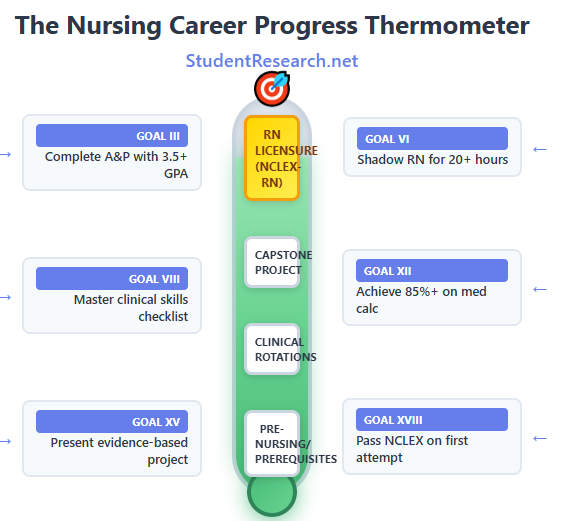
Continuing Education and Specialization
- Certs: Identifying which certifications (PALS, TNCC) are required for your dream job.
- Degree: Planning the timeline for a transition from BSN to MSN or DNP.
- Mentorship: Finding a mentor in your desired specialty to guide your path.
Conclusion: Cementing Your Future in Healthcare
In conclusion, the path to becoming a highly competent nurse is paved with intentionality. By consistently applying smart goals for nursing students examples, you transform from a passive learner into a proactive clinician. This structured approach not only ensures academic success but also builds the resilience and skill set necessary for a lifelong career in service to others. Master your career with smart goals for nursing students examples. This guide offers 28 tips for academic and clinical excellence. Start today!
Final Countdown of SMART Examples
- Goal XXV: “I will volunteer for 10 hours at a community health clinic to improve my cultural competency.”
- Goal XXVI: “I will perfect my ‘hand-washing’ and ‘sterile field’ technique, passing my lab check-off on the first attempt.”
- Goal XXVII: “I will read two nursing journals per month to stay updated on the latest evidence-based practices.”
- Goal XXVIII: “I will complete my final capstone project 1 week before the deadline to allow for thorough peer review.”

