

Balancing a rigorous clinical schedule with the need for financial stability can feel like a high-stakes surgical procedure. Finding the right jobs for nursing students isn’t just about the paycheck; it’s about securing a front-row seat to the healthcare world before you even graduate. In this guide, we dive deep into how you can bridge the gap between classroom theory and real-world bedside manner.
The Strategic Value of Early Healthcare Employment
Securing employment while still in school is a form of proactive student research into your future career path. These roles allow you to observe the workflow of a hospital unit and build rapport with potential future employers. By choosing the right position, you ensure your resume stands out in a competitive post-grad market.
Building Your Professional Foundation
- Networking: Connect with charge nurses and clinical directors who can provide future references.
- Skill Application: Practice basic vitals and patient communication in a low-pressure environment.
- Time Management: Balance shifts with study hours to prepare for the fast-paced life of an RN.
Navigating Academic and Financial Demands
- Tuition Assistance: Many hospitals offer “tuition reimbursement” for employees pursuing a BSN.
- Flexible Scheduling: Look for “PRN” or “Per Diem” roles that allow you to pick up shifts around your exam schedule.
- Stress Reduction: Consistent income reduces the financial anxiety that often plagues modern nursing candidates.
Drowning in care plans and research papers?” Let the experts at StudentResearch.net handle the heavy lifting. We provide top-tier academic writing support specifically for nursing students, ensuring you maintain a high GPA while focusing on your vital clinical shifts.
Top 10 High-Value Jobs for Nursing Students
Finding the perfect fit requires comparing the clinical exposure against the physical and mental demands of the role. This section highlights the best jobs for nursing students that offer a balance of education and income. We have ranked these based on their relevance to the NCLEX and general nursing curriculum.
Clinical and Patient-Facing Roles (#1 – #5)
- #1 Certified Nursing Assistant (CNA): Mastery of ADLs and bedside manner.H4: CNA Responsibilities
- Assist with bathing, dressing, and feeding.
- Measure and record vital signs (BP, Temp, Pulse).
- Perform safe patient transfers and repositioning.
- #2 Patient Care Technician (PCT): Advanced clinical tasks in hospital settings.H4: PCT Responsibilities
- Perform EKGs and basic wound care.
- Draw blood (Phlebotomy) and collect specimens.
- Monitor specialized equipment under RN supervision.
- #3 Student Nurse Extern: Immersive role for advanced students.H4: Extern Responsibilities
- Perform sterile procedures (Catheters/IV starts) where permitted.
- Shadow RNs during complex patient assessments.
- Participate in unit-based multidisciplinary huddles.
- #4 Home Health Aide: Independent care in residential settings.H4: HHA Responsibilities
- Manage medication reminders and simple treatments.
- Assist with light housekeeping and meal prep for seniors.
- Document daily progress for agency supervisors.
- #5 Psychiatric Aide: Focus on behavioral health and safety.H4: Psych Aide Responsibilities
- De-escalate aggressive or agitated patients.
- Facilitate therapeutic group activities.
- Monitor for safety and maintain “one-on-one” observation logs.
Specialized and Administrative Support (#6 – #10)
- #6 Medical Scribe: Charting directly for physicians.H4: Scribe Responsibilities
- Accompany doctors into exams to record histories.
- Chart lab results and diagnostic imaging findings.
- Learn real-world medical coding and documentation.
- #7 Monitor Technician: Specialized cardiac rhythm analysis.H4: Monitor Tech Responsibilities
- Observe telemetry monitors for rhythm changes.
- Notify nursing staff of lethal arrhythmias immediately.
- Interpret and print cardiac strips for medical charts.
- #8 Phlebotomist: Specializing in venipuncture.H4: Phlebotomist Responsibilities
- Obtain blood samples via venipuncture or capillary sticks.
- Label and transport specimens according to lab protocol.
- Manage patient anxiety during invasive procedures.
- #9 Unit Clerk: The administrative hub of the nursing floor.H4: Unit Clerk Responsibilities
- Coordinate patient admissions, transfers, and discharges.
- Answer call lights and direct family inquiries.
- Manage unit inventory and order medical supplies.
- #10 Laboratory Assistant: Supporting diagnostic student research.H4: Lab Assistant Responsibilities
- Prepare slides and process tissue or fluid samples.
- Maintain laboratory equipment and ensure sterility.
- Data entry for experimental or diagnostic student research results.
Interview Mastery: Questions for Aspiring Student Nurses
Landing one of these jobs for nursing students requires more than just a good GPA; you must prove your clinical judgment. Interviewers often use behavioral questions to see how you handle stress and prioritize patient safety. Below is a comprehensive list of questions you should prepare for.
Common Behavioral Interview Questions
- “Tell me about a time you had to deal with a difficult person.” Focus on your de-escalation skills and empathy.
- “How do you handle a situation where you are asked to perform a task outside your scope of practice?” The correct answer always involves patient safety and professional boundaries.
- “Give an example of a time you worked effectively as part of a team.” Highlight a time you supported a coworker during a busy shift.
- “Where do you see yourself in five years?” Mention your goal of becoming a licensed RN and your desire to grow within their facility.
- “Describe a time you made a mistake. How did you handle it?” Emphasize honesty, reporting the error immediately, and learning from the experience.
Role-Specific Clinical Scenarios
- For CNA/PCT: “What would you do if a patient refused their bath or vital sign check?”
- For Externs: “How do you prioritize your tasks when you have three patients needing assistance simultaneously?”
- For Monitor Techs: “If you see a sudden change in a heart rhythm, what are your immediate next steps?”
- For Home Health: “How would you manage a situation where a patient’s home environment seems unsafe?”
- For Scribes: “How do you handle a fast-paced environment where a doctor is moving quickly between patients?”
Questions to Ask the Interviewer
- “How does this unit support the scheduling needs of nursing students?”
- “What opportunities are there for me to observe advanced nursing procedures?”
- “How do you measure success for someone in this role during their first 90 days?”
Comparative Analysis: Clinical vs. Non-Clinical Roles
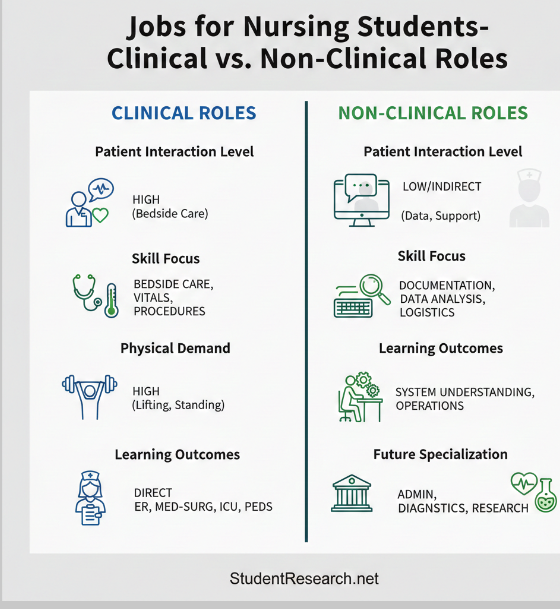
Choosing between a hands-on patient role and a technical support role depends on your personal energy levels. While clinical roles prepare you for the bedside, technical roles can offer a much-needed mental break from patient interaction. Use the table below to weigh your options for jobs for nursing students.
| Feature | Clinical Roles (CNA/PCT) | Technical Roles (Scribe/Tech) |
| Physical Demand | High (lifting, standing) | Low to Moderate |
| Skill Mastery | Hands-on patient care | Diagnostic/Documentation focus |
| Networking | High interaction with RNs | High interaction with MDs/Specialists |
| Stress Level | High during busy shifts | Moderate (accuracy is key) |
Essential Resources for the Working Student
To succeed in both your job and your degree, you need the right tools to stay organized and efficient. This section serves as your commercial guide to the products that make jobs for nursing students more manageable. Investing in quality gear now prevents burnout and physical injury later.
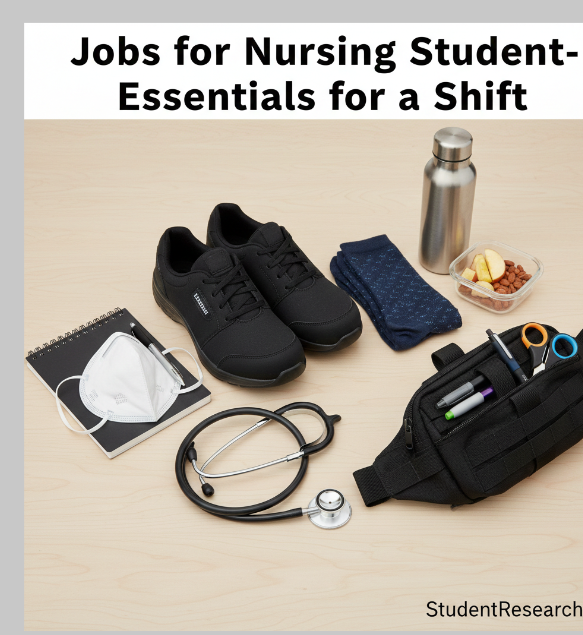
Must-Have Gear for New Healthcare Workers
- Compression Socks: Essential for 12-hour shifts to prevent leg fatigue and swelling.
- Quality Stethoscopes: Brands like Littmann offer “Student Editions” that provide clear acoustics for learning.
- Supportive Footwear: Look for non-slip, high-arch support shoes designed for healthcare professionals.
Recommended Study and Career Platforms
- NCLEX Prep Apps: Use “UWorld” or “Archer” during your lunch breaks to keep your knowledge sharp.
- Professional Resume Builders: Tailor your experience to highlight your student research and clinical hours.
- LinkedIn Learning: Take short courses on “Crucial Conversations” to improve your workplace communication.
“Need a flawless case study by tomorrow?” At StudentResearch.net, we specialize in professional medical writing that meets rigorous academic standards. Save your time for hands-on experience and let us polish your assignments to perfection with guaranteed on-time delivery.
To help you land one of these competitive jobs for nursing students, your cover letter needs to highlight both your academic progress and your hands-on potential. This template is designed for a Student Nurse Extern position (Role #3), but it can be easily adapted for a CNA or PCT role.
Professional Cover Letter Template for Nursing Students
- Header: Include your name, contact info, and LinkedIn profile.
- The Hook: State your current semester and your specific interest in that hospital unit.
- The Value Prop: Connect your student research and clinical rotations to the job requirements.
[Your Name] [Your Phone Number] | [Your Email] [Your City, State] | [LinkedIn Profile Link] [Date] [Hiring Manager Name] [Title, e.g., Nurse Manager or Talent Acquisition] [Hospital/Facility Name] [Address]
RE: Application for Student Nurse Extern Position – [Unit Name, e.g., Medical-Surgical]
Dear [Hiring Manager Name],
As a dedicated third-year nursing student at [University Name] with a current 3.8 GPA, I am thrilled to apply for the Student Nurse Extern position at [Hospital Name]. Having recently completed my clinical rotations in [Specific Specialty], I have developed a deep appreciation for the fast-paced, patient-centered care that your facility is known for. I am eager to contribute to your team while further refining my clinical skills in a professional environment that prioritizes excellence and safety.
Throughout my academic journey and preliminary student research, I have focused on mastering the fundamentals of patient assessment, sterile technique, and therapeutic communication. During my last rotation at [Hospital Name where you did clinicals], I successfully assisted in the care of a diverse patient load, consistently receiving praise from my preceptors for my proactive attitude and attention to detail. I am confident that my ability to balance a rigorous academic schedule with the demands of a clinical floor makes me an ideal candidate for this role.
I am particularly drawn to [Hospital Name] because of your reputation for [mention a specific hospital achievement, e.g., Magnet Status or a specific community program]. I am eager to bring my work ethic and passion for nursing to your [Specific Unit] team. Thank you for your time and for considering my application; I look forward to the possibility of discussing how I can support your nursing staff and patients.
Sincerely,
[Your Name]Customizing Your Application for Success
Submitting a generic letter is a common mistake when applying for jobs for nursing students. To stand out, you must tailor your “Value Prop” section to the specific mission statement of the hospital. This shows the hiring manager that you have done your student research and are genuinely invested in their specific culture.
Key Tips for a Standout Letter
- Quantify Your Experience: Instead of saying “I helped patients,” say “I assisted in the daily care of 5-7 patients per shift during my clinical rotation.”
- Mention Software: If you have experience with specific Electronic Health Records (EHR) like Epic or Cerner, mention it—it saves them training time.
- Highlight Soft Skills: Emphasize “adaptability” and “eagerness to learn,” as these are the two traits managers value most in student workers.
Common Pitfalls to Avoid
- Being Too Academic: While grades matter, managers care more about your ability to show up on time and work well with the team.
- Vague Availability: Nursing students have complex schedules; be clear (but flexible) about your weekend or night-shift availability.
- Grammatical Errors: In healthcare, a typo on a chart is a safety risk; a typo on a cover letter suggests a lack of professional rigor.
Conclusion and Career Outlook
Balancing a job with nursing school is no small feat, but the rewards extend far beyond your bank account. By selecting one of these jobs for nursing students, you are effectively pre-boarding your career and ensuring a smoother transition to licensed practice. Remember that your primary goal is graduation, so choose a role that supports your educational journey rather than hindering it.
As you conduct your student research into local hospital openings, keep your long-term goals in mind. Whether you choose to be a CNA or a Medical Scribe, the experience you gain today is the foundation of the nurse you will become tomorrow.
Final Note: Jobs for nursing students offer vital clinical experience and extra income. Discover the 10 best roles to kickstart your medical career today!

