

Defining the Role: What is an Externship Nursing Student?
The journey of an externship nursing student is a high-octane bridge between the theoretical safety of the classroom and the unpredictable reality of acute patient care. Unlike standard clinical rotations, which often feel like a “look-but-don’t-touch” experience, an externship places you in the heart of the unit as a functional member of the team. This role is designed to build the muscle memory and critical thinking skills that only come from consecutive, full-shift immersion.
Key Differences Between Externships and Clinical Rotations
- Increased Accountability: You are often assigned specific tasks that contribute directly to the unit workflow.
- Shift Consistency: Working the same schedule as your preceptor allows you to see the continuity of care over several days.
- Financial Incentives: Many hospitals offer a competitive hourly wage for an externship nursing student, recognizing the value of their labor.
The Scope of Practice for Student Externs
- Direct Patient Care: Mastering the fundamentals of hygiene, positioning, and nutrition.
- Diagnostic Assistance: Performing EKGs, blood glucose monitoring, and bladder scans.
- Documentation Skills: Gaining proficiency in professional charting that meets legal and medical standards.
The 11 Essential Secrets to Externship Success
To truly thrive as an externship nursing student, you must look beyond the basic tasks and focus on the “hidden curriculum” of the hospital. These eleven secrets represent the bridge between being a “helping hand” and being a vital part of the healthcare team. Each point is designed to help you navigate the complexities of a modern hospital environment while building your professional reputation.
1. Prioritize Time Management
- The “Brain” Sheet: Learn to organize your shift using a customized template for patient data.
- Task Grouping: Minimize trips to the supply room by gathering everything needed for multiple patients at once.
2. Master the Art of the Handover
- SBAR Utilization: Practice the Situation, Background, Assessment, and Recommendation framework religiously.
- Confidence in Reporting: Learn to speak up during shift change to ensure patient safety remains seamless.
3. Seek Out Diverse Procedures
- Observational Learning: Even if you can’t perform a task, ask to watch complex procedures like central line insertions.
- Hands-on Practice: Volunteer for every wound vac change or catheter insertion available on the floor.
4. Build Relationships with Ancillary Staff
- Interdisciplinary Respect: Understand that the CNA, Phlebotomist, and Janitorial staff are the backbone of the unit.
- Collaboration: Learn how to coordinate with Physical Therapy to safely ambulate a high-risk patient.
5. Engage in Student Research
- Evidence-Based Practice: Actively look for opportunities to participate in student research initiatives currently active on your unit.
- Process Improvement: Share findings from your school projects that might improve local unit protocols.
6. Develop Emotional Intelligence
- Patient Rapport: Learn to read the room and provide comfort to families in crisis.
- Conflict De-escalation: Observe how seasoned nurses handle frustrated patients without losing their composure.
7. Ask “Why,” Not Just “How”
- Clinical Reasoning: Don’t just hang a bag of fluids; understand why that specific tonicity was ordered.
- Lab Correlation: Connect a patient’s potassium levels to their cardiac rhythm on the monitor.
8. Anticipate the Needs of Your Preceptor
- Proactive Assistance: Have the supplies ready before the nurse even reaches for the IV port.
- Environmental Awareness: Keep the patient rooms tidy and the nursing station organized.
9. Document with Precision
- Legal Awareness: Chart as if a lawyer will read your notes in five years.
- Specificity: Use “2cm x 3cm stage II pressure injury” instead of “small sore on back.”
10. Embrace Feedback and Criticism
- Constructive Growth: Ask your preceptor, “What is one thing I could have done better this shift?”
- Ego Management: Understand that a correction is a tool for patient safety, not a personal attack.
11. Network for Future Employment
- Unit Visibility: Make sure the Unit Manager knows your name and sees your work ethic.
- Reference Building: Secure contact information for at least two RNs who can vouch for your clinical skills.
Navigating Interview Questions for the Aspiring Extern
The interview for an externship nursing student is often your first “real” professional healthcare interview. Managers are less interested in your ability to recite a textbook and more interested in your reliability, safety mindset, and cultural fit. Preparing for these specific queries ensures you present yourself as a prepared and professional future colleague who is ready to learn.
Common Behavioral Interview Questions
- The Priority Challenge: “Describe a time you had three competing tasks; how did you decide what to do first?”
- The Ethical Dilemma: “What would you do if you saw a more experienced nurse skipping a safety step?”
- The Team Player: “Tell us about a time you had a conflict with a clinical instructor and how you resolved it.”
Questions to Ask Your Interviewer
- Educational Support: “What specific mentorship structure do you have for an externship nursing student on this floor?”
- Growth Opportunities: “Are there opportunities to attend unit-based education or assist with ongoing student research?”
Mastering the STAR Method
- Situation: Briefly set the scene of your example.
- Task: Explain what you needed to accomplish.
- Action: Detail the specific steps you took (not the team).
- Result: Share the positive outcome or what you learned.
Ready to land your dream hospital residency? Stand out from the competition with StudentResearch.net. Our Admissions Support team crafts professionally polished personal statements and SOPs tailored for an externship nursing student, ensuring your application reflects the high-impact professional you are.
The Externship Nursing Student Resume Template
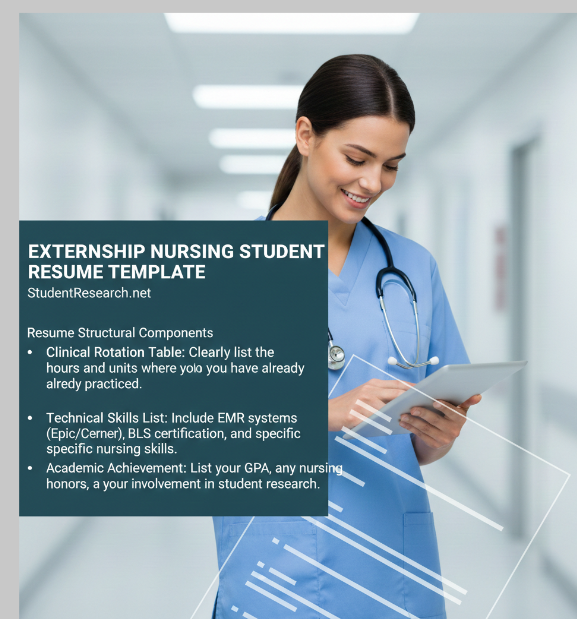
Your resume is the first impression you make on a hiring manager, and as a student, it must highlight potential over long-term experience. For an externship nursing student, the focus should be on your clinical rotations, your specific skills, and your academic dedication. This format ensures that even with a shorter work history, your clinical readiness is the star of the show.
Resume Structural Components
- Clinical Rotation Table: Clearly list the hours and units where you have already practiced.
- Technical Skills List: Include EMR systems (Epic/Cerner), BLS certification, and specific nursing skills.
- Academic Achievement: List your GPA, any nursing honors, and your involvement in student research.
| Section | What to Include | Why It Matters |
| Header | Name, Contact, LinkedIn, Nursing School. | Professionalism and accessibility. |
| Education | BSN/ADN Program, Expected Grad Date, GPA. | Shows your current standing in your education. |
| Clinical Exp. | Hospital Name, Unit Type, Key Tasks. | Proves you have handled real patient loads. |
| Certifications | BLS, ACLS (if applicable), CNA license. | Verifies your legal ability to provide care. |
Choosing the Right Environment: Externships vs. Internships
Deciding where to apply as an externship nursing student requires a clear understanding of the different educational models available in the hospital system. While both roles involve learning, the timing and level of responsibility differ significantly. Choosing the right fit depends on your long-term career goals and whether you want to explore a specialty early or wait until after graduation.
Comparing the Two Pathways
- Externships: Typically occur between the junior and senior year of a BSN program; focus is on skill-building.
- Internships: Often occur post-graduation (New Grad Residency); focus is on full independence.
- Student Status: An externship nursing student remains a student and works under a school-affiliated or hospital-specific student license.
Understanding Your Supervision
- Direct Supervision: An extern always works under the license of an RN preceptor.
- The “Safety Net”: The hospital provides additional layers of oversight to ensure the student learns without risk.
Essential Supplies: Pocket Checklist for Day One
Walking onto the unit as an externship nursing student can be nerve-wracking, but being physically prepared goes a long way in calming those first-day jitters. Your scrub pockets are your mobile office, and having the right tools on hand prevents unnecessary trips to the supply room. This checklist covers the basics that will help you stay organized and helpful from the very first hour.
Technical and Diagnostic Tools
- Stethoscope: Ensure it is high-quality enough to hear subtle heart and lung sounds.
- Penlight: Essential for pupil assessments and checking oral mucosa.
- Medical Scissors: Trauma shears are best for cutting bandages or opening stubborn packaging.
Documentation and Personal Essentials
- Multi-color Pen: Useful for color-coding different types of data on your “brain” sheet.
- Alcohol Pads: Keep a handful for quick cleaning of hub ports or equipment.
- Small Notebook: To jot down clinical pearls, medication names, or unit door codes.
Advanced Preparation Tips
- Hydration: Always have a water bottle with a secure lid kept in the designated staff area.
- Energy: Keep a small, high-protein snack in your pocket for those shifts where lunch gets delayed.
- Backup: Carry an extra pen—one will inevitably disappear by midday!
Struggling to decode complex clinical data? Master your nursing assignments with STEM Excellence from StudentResearch.net. We provide expert assistance with intricate lab reports, medical data analysis, and technical case studies to ensure your academic performance matches your clinical growth.
Overcoming Common Challenges in the Externship
Even the most prepared externship nursing student will face moments of doubt or overwhelming stress during their placement. The fast-paced nature of acute care can lead to “imposter syndrome,” where you feel like you don’t belong in such a high-stakes environment. Identifying these hurdles early allows you to develop coping mechanisms that will serve you throughout your entire career.
Managing Physical and Mental Demands
- The 12-Hour Fatigue: Develop a nutrition and sleep schedule that supports long days on your feet.
- Emotional Resilience: Learn to decompress after a difficult shift so you don’t carry the stress home.
Navigating Preceptor Relationships
- Communication Styles: Adapt your learning style to match your preceptor’s teaching style.
- Addressing Gaps: If you feel you aren’t getting enough hands-on time, speak up politely but firmly.
Dealing with Clinical Anxiety
- Preparation: Review the charts of your assigned patients thoroughly.
- Support: Don’t be afraid to ask for help; it’s the safest thing a student can do.
Conclusion: Your Future as a Professional Nurse
Becoming a successful externship nursing student is about more than just checking off clinical hours; it is about immersing yourself in the life-saving world of healthcare. The skills, connections, and confidence you build during this time will serve as the foundation for your entire career. As you move forward, remember that every interaction is an opportunity to learn and grow into the nurse your patients deserve.
Summary: Master your role as an externship nursing student with these 11 secrets to success. Gain clinical hours, expert mentorship, and a competitive edge.

