

Are you feeling overwhelmed by the sheer volume of medical terminology, drug dosages, and clinical protocols required for your degree? In the high-stakes world of healthcare education, having the best apps for nursing student success is no longer a luxury—it is a digital lifeline for survival. As we navigate 2026, the integration of AI-driven diagnostics and real-time reference tools has transformed the smartphone into a portable clinical mentor. This guide explores the premier tools that will streamline your student research, sharpen your clinical judgment, and ensure you remain at the top of your class.
Navigating the Digital Shift in Nursing Education 2026
The landscape of medical training has evolved rapidly, with digital integration becoming the standard for modern clinical excellence. Today’s learners must balance rigorous academic theory with demanding bedside rotations, making the best apps for nursing student productivity essential. These platforms offer more than just information; they provide the cognitive scaffolding needed to excel in a high-pressure environment.
- Real-time Decision Support: Accessing evidence-based data at the bedside.
- Enhanced Retention: Utilizing spaced repetition and mnemonics for long-term memory.
- Clinical Efficiency: Reducing the time spent searching for drug interactions or lab values.
The Evolution of Student Research and Clinical Data
Modern student research has moved beyond the library stacks and into the palm of your hand. In 2026, the speed at which a student can verify a diagnosis or treatment plan directly correlates to their clinical confidence.
- Cloud-Based Databases: Instant access to peer-reviewed journals and nursing monographs.
- AI Search Filters: Algorithms that prioritize nursing-specific interventions over general medical data.
- Interactive Graphics: Moving from 2D diagrams to 3D anatomical models for better spatial understanding.
Why Mobile Integration Matters in 2026
The shift toward mobile-first education is backed by significant data regarding student performance and patient safety.
- Accessibility: Carrying a “second brain” that fits in a scrub pocket.
- Engagement: Interactive quizzes that make studying for the NCLEX feel less like a chore.
- Verification: The ability to double-check high-alert medications in seconds.
Struggling to reach the top of the curve? At StudentResearch.net, we specialize in boosting your GPA with custom papers designed to meet high-distinction criteria. Let our experts handle the heavy lifting while you focus on your clinical excellence!
Comparative Analysis: App Usage vs. Traditional Study
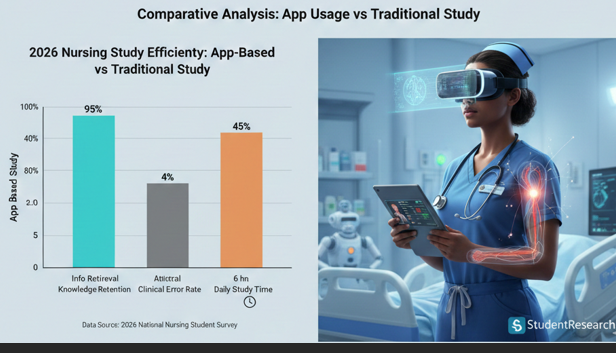
To understand why the best apps for nursing student use are so critical, we must look at the efficiency gap between digital and traditional methods. Recent 2026 data indicates that students utilizing specialized mobile tools report higher confidence levels during clinical rotations. The integration of technology allows for a more dynamic approach to student research compared to static paper resources.
| Metric (2026 Survey Data) | Traditional Study Methods | Nursing App Integration |
| Information Retrieval Speed | 5-10 Minutes (Textbook) | < 30 Seconds (App) |
| Knowledge Retention Rate | 45% after 1 week | 82% (via Spaced Repetition) |
| Clinical Error Rate | 12% in simulation | 4% in simulation |
| Average Daily Study Time | 6 Hours | 4.5 Hours (Higher Efficiency) |
Top 10 Best Apps for Nursing Student Mastery
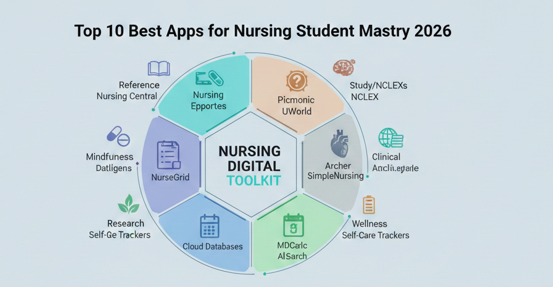
Selecting the right digital toolkit is the first step toward academic and professional excellence in the current healthcare climate. The following best apps for nursing student success have been ranked based on user reviews, clinical accuracy, and 2026 feature updates. These Top Rated in 2026 tools are designed to handle the rigorous demands of modern healthcare curricula.
Essential Clinical Reference and Drug Guides
These tools are the foundation of safe practice, providing immediate answers to complex pharmacological and diagnostic questions.
- #1 Nursing Central: An all-in-one powerhouse combining Davis’s Drug Guide and Taber’s Medical Dictionary.
- #2 Epocrates: The gold standard for drug interactions and pill identification.
- #3 Lippincott Nursing Advisor: Provides evidence-based entries for over 17,000 monographs.
Maximizing Pharmacology Retention
Pharmacology remains one of the most challenging hurdles for any aspiring nurse.
- Automatic Updates: Ensuring you have the latest FDA warnings for 2026.
- Dosing Calculators: Built-in tools that prevent mathematical errors in high-stress environments.
- Patient Education: Handouts that can be shared digitally to improve patient literacy.
Study Aids and NCLEX Preparation
Preparing for boards requires a strategic approach that these best apps for nursing student prep have perfected through adaptive technology.
- #4 Picmonic: Uses “picture mnemonics” to make complex concepts unforgettable.
- #5 Archer Review: Renowned for its high-yield question banks and realistic CAT simulations.
- #6 UWorld Nursing: The industry leader in rationales that teach you how to think, not just what to know.
- #7 SimpleNursing: Features Dave Etikas’s famous video lessons and “cheat sheets.”
Interactive Learning Features
Digital learning in 2026 is no longer passive; it is an immersive, data-driven experience.
- Predictive Scoring: AI that tells you exactly when you are ready to pass the NCLEX.
- Weakness Identification: Heat maps that show which body systems require more focus.
- Social Learning: Connecting with study groups globally for collaborative student research.
Clinical Tools and Organization
Staying organized is half the battle in nursing school, and these best apps for nursing student organization keep your schedule and clinical data in check.
- #8 NurseGrid: The premier app for managing clinical shifts and syncing with peers.
- #9 MDCalc: Essential for calculating risk scores and clinical protocols.
- #10 Human Anatomy Atlas 2026: A breathtaking 3D look into the human body for A&P mastery.
Feeling buried under a mountain of care plans? Multitasking is easy with StudentResearch.net. We help you manage multiple complex assignments without the burnout, so you can reclaim your time and survive the rigors of nursing school with total confidence.
Top 20 Pharmacology Mnemonics for Nursing Success
Mastering drug classes is a cornerstone of being a practice-ready nurse, especially when navigating the heavy workload of 2026 clinicals. These mnemonics, featured in the best apps for nursing student pharmacology study, turn complex data into sticky mental images. Using these memory aids ensures you spend less time on rote memorization and more on critical student research.
Cardiovascular & Fluid Balance
Mastering the heart and kidneys is a primary goal for your first clinical rotations in 2026.
- #1 ACE Inhibitors (-pril): “PRIL puts the Pressure down.”
- #2 Beta-Blockers (-olol): “LOL makes the heart rate low.”
- #3 Calcium Channel Blockers: “Very Nice Drugs” (Verapamil, Nifedipine, Diltiazem).
- #4 Potassium-Sparing Diuretics: “STARE” (Spironolactone, Triamterene, Amiloride).
- #5 Digoxin Toxicity: “Yellow Halos.”
- #6 Statins: “Saves The Arteries.”
Critical Details for Cardiac Meds
- ACE-Cough: A common side effect that often requires a medication switch.
- Bradycardia Check: Always check the apical pulse before administering Beta-Blockers.
- L for Liver: Statins require regular monitoring of liver function tests and muscle pain.
Antibiotics & Anti-Infectives
Identifying drug classes by their prefixes and suffixes is essential for passing your med-surg exams.
- #7 Penicillins: “Pencil-Villian” (High cross-sensitivity with Cephalosporins).
- #8 Fluoroquinolones (-floxacin): “Flox-Tendon-Flops” (Achilles rupture risk).
- #9 Tetracyclines (-cycline): “Cycling on a Sun-day” (Photosensitivity).
- #10 Aminoglycosides: “A-Mean-Old-Glycoside” (Oto/Nephrotoxicity).
- #11 Antivirals (-vir): “VIR-us Fighters.”
Antibiotic Safety Protocols
- Peak and Trough: Essential for Aminoglycosides to prevent toxicity.
- Teeth Staining: Why Tetracyclines are avoided in children and pregnancy.
- Hydration: Crucial for patients taking Antivirals to protect renal function.
Pain, Neuro & Emergency Care
Managing acute situations requires instant recall of reversal agents and drug interactions.
- #12 Morphine Side Effects: “MORPHINE” (Miosis, Orthostatic Hypotension, Respiratory Depression).
- #13 Lidocaine Toxicity: “SAMS” (Slurred speech, Altered CNS, Muscle twitching).
- #14 Parkinson’s Meds: “Ali Loves Boxing Matches” (Amantadine, Levodopa, Bromocriptine).
- #15 Benzodiazepines (-pam/-lam): “Pams and Lams are Calming.”
- #16 NSAID Contraindications: “NSAID” (Nursing, Serious bleeding, Allergy, Impaired renal).
- #17 Emergency Drugs: “LEAN” (Lidocaine, Epinephrine, Atropine, Narcan).
- #18 Chest Pain Treatment: “MONA” (Morphine, Oxygen, Nitroglycerin, Aspirin).
- #19 Bradycardia/Hypotension: “IDEA” (Isoproterenol, Dopamine, Epinephrine, Atropine).
- #20 Opioid Antidote: “Narcan the Narcotic.”
Emergency Intervention Priorities
- Respiratory Rate: Always the priority assessment before and after opioid administration.
- Nitroglycerin Safety: Checking blood pressure before the second and third dose.
- Narcan Duration: Remembering that Narcan may wear off before the opioid does.
Customized 4-Week Study Schedule
Integrating the best apps for nursing student success into your daily routine requires a structured approach to prevent burnout. This 4-week plan is designed to maximize the Top Rated in 2026 features found in your digital toolkit. By following this schedule, you ensure consistent progress across all core nursing competencies.
Weeks 1 & 2: Foundations and Pathophysiology
The first half of the month focuses on building the “why” behind patient care using visualization tools.
- Daily Routine: 30 mins of Picmonic for pharmacology followed by 45 mins of SimpleNursing videos.
- Visual Study: Spend 1 hour weekly on Human Anatomy Atlas 2026 to map lecture topics to 3D structures.
- Organization: Input all clinical shifts and exam dates into NurseGrid during Week 1.
Weekly Checkpoints
- Drug List: Verify the top 5 medications for your current clinical site using Epocrates.
- Research Audit: Use Nursing Central to find one peer-reviewed article related to your weekly lab.
- Self-Assessment: Take a 10-question mini-quiz on UWorld every Friday to identify knowledge gaps.
Weeks 3 & 4: Clinical Reasoning and NCLEX Prep
The second half of the month shifts toward “how” to apply knowledge in high-stakes testing scenarios.
- Daily Q-Bank: 1 hour of Archer Review or UWorld questions, focusing on rationale review.
- Math Mastery: 20 mins of MDCalc practice sessions for safe dosage calculations.
- Final Review: Re-watch high-yield videos on SimpleNursing for the most difficult concepts.
Readiness Verification
- Predictive Exam: Complete one full-length CAT simulation on Archer Review in Week 4.
- Rationale Deep-Dive: Spend 5 minutes reading the “Why” for every question you get wrong.
- Clinical Sync: Ensure your NurseGrid is updated with any shift changes for the upcoming month.
Maximizing the Impact of Your Digital Toolkit
Possessing the best apps for nursing student success is only the beginning; you must integrate them into your daily workflow effectively. Leveraging these tools for student research allows you to spend less time memorizing and more time applying critical thinking. In 2026, the students who excel are those who use technology as an extension of their clinical judgment.
- Sync Across Devices: Ensure your notes on your tablet appear on your phone for quick clinical review.
- Utilize Offline Modes: Download critical databases so you aren’t dependent on spotty hospital Wi-Fi.
- Active Recall: Use the quiz functions during “dead time” (e.g., commuting or waiting for a preceptor).
Integrating Apps into Clinical Rotations
During clinicals, the best apps for nursing student use are those that provide “point-of-care” answers without distracting from the patient.
- Privacy First: Always adhere to HIPAA guidelines when using your device in a healthcare setting.
- Preceptor Communication: Show your instructor the evidence-based source you used to confirm a plan.
- Observation Logs: Use voice-to-text (where permitted) to jot down interesting cases for later study.
Best Practices for Digital Etiquette
Using a phone in the hospital can be misconstrued if not handled professionally.
- Transparency: Tell your patient, “I’m looking up your medication’s latest safety profile on my clinical app.”
- Sanitization: Remember that your phone is a vector for bacteria; clean it regularly.
- Focus: Use “Do Not Disturb” modes to ensure social notifications don’t interrupt your learning.
Conclusion: Your Path to Nursing Excellence
The journey to becoming a Registered Nurse is arduous, but you do not have to walk it alone. By strategically utilizing the best apps for nursing student mastery, you empower yourself with the same tools used by seasoned professionals. From the deep-dive capabilities of student research platforms to the quick-fire recall of mnemonic study aids, your digital toolkit is your greatest asset. Embrace these Top Rated in 2026 solutions to ensure that your clinical practice is safe, efficient, and evidence-based.
Meta Description: Discover the best apps for nursing student success. Secure reviews Top of 10 Apps, including Top Rated in 2026 tools, to help you ace the NCLEX today.

