

Entering the world of nursing often feels like learning a beautiful but complex new language, and your first major hurdle is the “Big Two.” Mastering anatomy and physiology notes for nursing students is more than just a prerequisite; it is the fundamental blueprint for every clinical decision you will ever make. Without a deep understanding of how the body is built and how it functions, providing high-quality patient care becomes an impossible puzzle.
Introduction to Mastering the Human Blueprint
The journey to becoming a Registered Nurse begins with a solid foundation in the biological sciences. Creating effective anatomy and physiology notes for nursing students allows you to bridge the gap between textbook theory and real-world clinical application. This guide provides 25 actionable tips to help you organize your study habits, retain complex information, and ultimately excel in your exams and your future career.
Why Foundation Matters in Nursing
Understanding the “why” behind your studies is the first step toward long-term retention. When you study the body, you aren’t just memorizing parts; you are learning the “normal” so you can recognize the “abnormal” in your patients.
- Tip #1: Connect Structure to Function
- H4: Mechanical Realities
- Always ask how a bone’s shape facilitates movement.
- Relate the thinness of alveolar walls to the speed of gas exchange.
- H4: Mechanical Realities
- Tip #2: Prioritize Homeostasis
- H4: The Balance Act
- Focus on how the body maintains a “steady state.”
- Study feedback loops (positive vs. negative) as the core of physiology.
- H4: The Balance Act
- Tip #3: Adopt a Clinical Mindset
- H4: Patient-Centered Study
- Visualize a patient presenting with a specific organ failure.
- Think about which symptoms stem from specific physiological breakdowns.
- H4: Patient-Centered Study
Essential Terminology and Directional Language
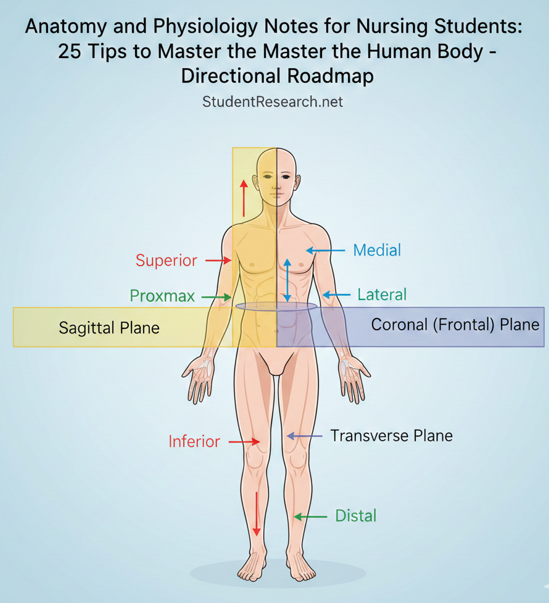
Before you can dive into organ systems, you must master the vocabulary that healthcare professionals use to communicate. Your anatomy and physiology notes for nursing students should serve as a personal dictionary for anatomical positions and planes. This section ensures you never confuse “proximal” with “distal” when documenting patient findings.
The Language of Anatomy
Precision is vital in nursing to ensure patient safety and accurate charting. Mastering these terms early prevents embarrassing and dangerous errors during clinical rotations.
- Tip #4: Master Directional Terms
- H4: Mapping the Body
- Use “Superior” and “Inferior” for vertical relationships.
- Use “Medial” and “Lateral” for proximity to the midline.
- H4: Mapping the Body
- Tip #5: Understand Body Planes
- H4: Slicing the Data
- Sagittal: Dividing left from right.
- Frontal (Coronal): Dividing front from back.
- Transverse: Dividing top from bottom.
- H4: Slicing the Data
- Tip #6: Memorize Regional Terms
- H4: Specific Locations
- Learn “Axillary” instead of just “armpit.”
- Use “Antecubital” for the front of the elbow (vital for IV starts).
- H4: Specific Locations
Cellular Biology and Tissue Classification
Every complex disease starts at the microscopic level, making cellular biology a cornerstone of your study. Detailed A&P notes for nursing students must cover how cells communicate and how different tissue types perform specialized roles. By understanding the building blocks, you can better grasp how systemic pathologies, like cancer or inflammation, take hold.
From Cells to Systems
Cells are the functional units of life, and their health determines the health of the entire organism. If you understand cellular transport, you will understand how medications move through the bloodstream.
- Tip #7: Visualize the Plasma Membrane
- H4: The Gatekeeper
- Study the phospholipid bilayer’s role in selective permeability.
- Note how active transport requires ATP, unlike passive diffusion.
- H4: The Gatekeeper
- Tip #8: Categorize the Four Tissue Types
- H4: Histology Essentials
- Epithelial: Protection and secretion.
- Connective: Support and integration.
- Muscle: Movement and heat generation.
- Nervous: Communication and control.
- H4: Histology Essentials
- Tip #9: Map Out Organelles
- H4: The Cell’s Machinery
- Mitochondria: The “Powerhouse” producing ATP.
- Ribosomes: The protein factories essential for repair.
- H4: The Cell’s Machinery
| Feature | Passive Transport | Active Transport |
| Energy Required | No (Uses kinetic energy) | Yes (Requires ATP) |
| Direction | High to Low concentration | Low to High concentration |
| Examples | Simple diffusion, Osmosis | Sodium-Potassium pump, Exocytosis |
The Skeletal and Muscular Systems
Mobility is a primary focus of nursing care, especially in rehabilitation and geriatric settings. Developing robust anatomy and physiology notes for nursing students regarding the musculoskeletal system allows you to assist with patient transfers and understand fracture healing. This section breaks down the framework and the engines of the human body.
The Framework of Movement
Bones provide the structure, while muscles provide the force. Understanding the interaction between the two is essential for assessing physical injuries and range of motion.
- Tip #10: Axial vs. Appendicular Skeleton
- H4: The Core and the Limbs
- Axial: Skull, vertebral column, and rib cage (Protection).
- Appendicular: Limbs and girdles (Movement).
- H4: The Core and the Limbs
- Tip #11: Learn Bone Remodeling
- H4: Dynamic Tissue
- Focus on Osteoblasts (builders) vs. Osteoclasts (breakers).
- Understand how calcium levels regulate bone density.
- H4: Dynamic Tissue
- Tip #12: Muscle Contraction (Sliding Filament Theory)
- H4: The Molecular Pull
- Note the role of Calcium and ATP in sarcomere shortening.
- Remember that muscles only pull, they never push.
- H4: The Molecular Pull
- Tip #13: Identify Key Bony Landmarks
- H4: Clinical Application
- Locate the iliac crest for injections.
- Find the spinous processes for assessing spinal alignment.
- H4: Clinical Application
Struggling to structure your complex medical essays?
See the gold standard of nursing papers before you buy! Visit StudentResearch.net to browse our extensive portfolio of high-quality sample work. Our transparent previews ensure you make an informed decision by witnessing our academic excellence firsthand.
The Nervous and Endocrine Systems
Communication is the “control center” of the body, managed by the lightning-fast nervous system and the slower, chemical endocrine system. Your anatomy and physiology notes for nursing students must distinguish between these two to understand how the body responds to stress. This section is vital for understanding neurological assessments and hormonal imbalances like Diabetes.
Integration and Control
The brain and glands work in tandem to ensure every other system stays in check. A failure in these systems leads to a cascade of issues across the entire body.
- Tip #14: The CNS vs. PNS Split
- H4: Nervous Architecture
- CNS: Brain and Spinal Cord (The processor).
- PNS: Nerves branching to limbs (The messengers).
- H4: Nervous Architecture
- Tip #15: Autonomic Nervous System (ANS)
- H4: Fight or Flight
- Sympathetic: Increases heart rate and dilates pupils.
- Parasympathetic: “Rest and Digest” functions.
- H4: Fight or Flight
- Tip #16: Master the Endocrine Glands
- H4: Chemical Messengers
- Pituitary: The “Master Gland.”
- Pancreas: Regulates blood glucose via Insulin and Glucagon.
- H4: Chemical Messengers
- Tip #17: Action Potentials
- H4: Electrical Signaling
- Study Depolarization (Sodium in) and Repolarization (Potassium out).
- Understand the “All-or-None” principle of nerve firing.
- H4: Electrical Signaling
Cardiovascular and Respiratory Dynamics
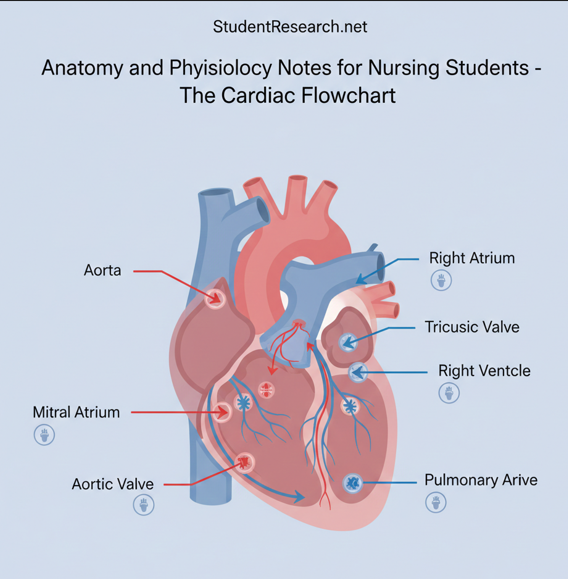
The “pump and the bellows” work together to deliver oxygen to tissues and remove metabolic waste. High-quality anatomy and physiology notes for nursing students are non-negotiable here, as cardiovascular disease remains a leading cause of patient hospitalization. Mastering these systems will help you interpret EKGs and lung sounds with confidence.
Transport and Gas Exchange
The heart and lungs are physically and functionally linked. If one fails, the other is forced to compensate, which is a key concept in cardiac nursing.
- Tip #18: Follow the Path of Blood
- H4: Cardiac Circuitry
- Right Side: Deoxygenated blood to the lungs (Pulmonary).
- Left Side: Oxygenated blood to the body (Systemic).
- H4: Cardiac Circuitry
- Tip #19: Cardiac Output Calculations
- H4: Vital Stats
- $CO = Stroke Volume \times Heart Rate$.
- Understand how dehydration lowers stroke volume.
- H4: Vital Stats
- Tip #20: The Mechanics of Breathing
- H4: Pressure Changes
- Inspiration: Diaphragm contracts, volume increases, pressure drops.
- Expiration: Passive recoil of lung tissue.
- H4: Pressure Changes
- Tip #21: The Oxyhemoglobin Dissociation Curve
- H4: Oxygen Delivery
- Learn how pH and temperature affect oxygen’s “stickiness” to blood.
- This is crucial for understanding respiratory acidosis.
- H4: Oxygen Delivery
Digestion, Metabolism, and Renal Function
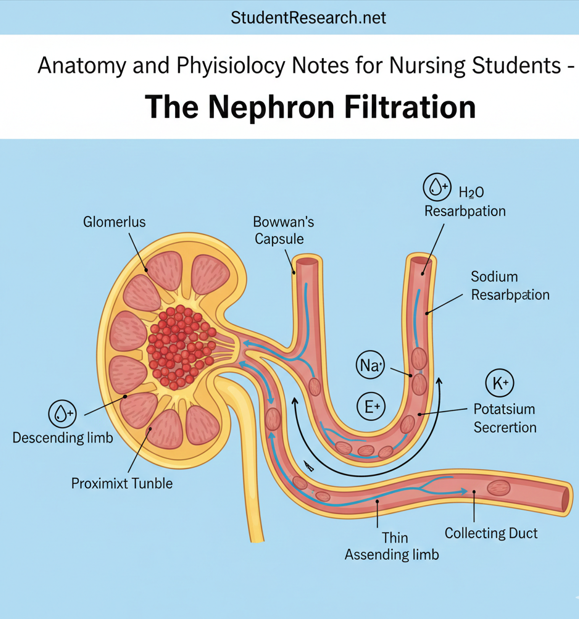
Filtering the blood and fueling the body are the final pieces of the physiological puzzle. Detailed anatomy and physiology notes for nursing students regarding the kidneys are particularly important for understanding fluid and electrolyte balance. This section covers how we turn food into energy and how we get rid of the “trash” through the renal system.
Fueling and Filtration
The gut absorbs nutrients while the kidneys maintain the chemistry of the blood. Nursing students must understand these to manage patient nutrition and catheterization.
- Tip #22: The Nephron’s Journey
- H4: Micro-Filtration
- Glomerulus: Bulk filtration.
- Tubules: Reabsorption of what the body needs (Glucose, Water).
- H4: Micro-Filtration
- Tip #23: Digestive Enzymes and Organs
- H4: Chemical Breakdown
- Liver: Produces bile for fat emulsification.
- Small Intestine: The primary site of nutrient absorption.
- H4: Chemical Breakdown
- Tip #24: Electrolyte Balance
- H4: Chemical Harmony
- Sodium: Follows water; essential for BP.
- Potassium: Critical for heart rhythm.
- H4: Chemical Harmony
- Tip #25: The Renin-Angiotensin-Aldosterone System (RAAS)
- H4: Blood Pressure Control
- Understand how the kidneys raise BP during shock.
- This is the target of many common blood pressure medications.
- H4: Blood Pressure Control
Conclusion
Mastering the human body is a marathon, not a sprint, and your dedication today will save lives tomorrow. Using organized anatomy and physiology notes for nursing students ensures that you aren’t just memorizing for a grade, but building a mental library for your future practice. By applying these 25 tips, you transform from a student into a clinician who understands the “How” and “Why” of human health.
Staying the Course
Consistency is more important than “cramming.” Review your notes daily and try to explain complex concepts to a peer to solidify your understanding.
- Continuous Review: Revisit old systems while learning new ones.
- Active Recall: Use flashcards and practice quizzes.
- Visual Aids: Draw your own diagrams to visualize the pathways.
Final Note: Master your anatomy and physiology notes for nursing students with these 25 expert tips. Get proven strategies to excel in your nursing career.

