

Your Roadmap to Clinical Success
Picture this: You’re standing at the threshold of your first clinical rotation, white coat crisp, stethoscope in hand, and your heart racing with equal parts excitement and anxiety. Every nursing student experiences this transformative moment when theoretical knowledge must translate into real-world patient care. The bridge between classroom learning and clinical competence isn’t built on hope alone—it’s constructed through carefully defined, actionable objectives that guide your professional development.
Understanding the objectives for nursing students in clinical settings is crucial for maximizing your learning experience and building the foundation for your nursing career. These objectives serve as your compass, helping you navigate the complex healthcare environment while developing critical skills, clinical judgment, and professional behaviors. Whether you’re entering your first clinical placement or advancing through specialized rotations, having clear goals transforms overwhelming experiences into structured learning opportunities that shape you into a competent, confident healthcare professional.
This comprehensive guide explores 14 essential objectives for nursing students in clinical environments, providing you with a strategic framework to excel in patient care, master technical skills, develop critical thinking abilities, and cultivate the professional attributes that define outstanding nurses. Let’s embark on this journey toward clinical excellence together.
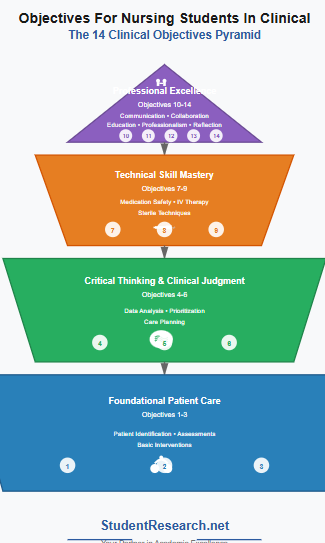
Foundational Patient Care Objectives
Mastering patient care fundamentals forms the cornerstone of every successful nursing career. These foundational objectives for nursing students in clinical practice establish the baseline competencies you’ll build upon throughout your professional journey. Without solid mastery of basic patient care principles, advanced skills become exponentially more challenging to acquire.
Objective 1 – Demonstrate Safe Patient Identification and Documentation
Why This Matters:
- Patient safety begins with accurate identification using at least two identifiers
- Proper documentation creates legal protection and ensures continuity of care
- Electronic health records require meticulous attention to detail and confidentiality
Key Action Steps:
- Verify patient identity using name and date of birth before every intervention
- Document assessments, interventions, and patient responses in real-time
- Maintain HIPAA compliance in all verbal and written communications
- Use standardized terminology and abbreviations approved by your facility
Objective 2 – Perform Comprehensive Head-to-Toe Assessments
Essential Assessment Components:
- Vital signs measurement and interpretation within normal parameters
- Systematic evaluation from neurological to musculoskeletal systems
- Recognition of abnormal findings requiring immediate intervention
- Integration of subjective patient reports with objective clinical data
Clinical Application: Conducting thorough assessments allows you to establish baselines, detect changes in patient conditions, and prioritize interventions effectively. This objective for nursing students in clinical practice develops your observational skills and clinical reasoning abilities simultaneously.
Objective 3 – Execute Basic Nursing Interventions with Competence
Core Interventions to Master:
- Medication administration via multiple routes (oral, IV, IM, subcutaneous)
- Wound care including dressing changes and assessment
- Catheter insertion and maintenance (urinary and IV)
- Patient hygiene and comfort measures
- Mobility assistance and fall prevention strategies
Critical Thinking and Clinical Judgment Development
Critical thinking separates task-oriented care from truly therapeutic nursing practice. These objectives for nursing students in clinical rotations focus on developing the analytical skills necessary to make sound clinical judgments under pressure. The ability to synthesize information, anticipate complications, and adjust care plans dynamically defines nursing expertise.
Objective 4 – Analyze Assessment Data to Identify Patient Problems
Data Analysis Framework:
| Assessment Type | Clinical Application | Priority Level |
|---|---|---|
| Abnormal vital signs | Immediate intervention required | High |
| Pain assessment | Comfort measures and medication | Medium-High |
| Lab value deviations | Trending and reporting | Variable |
| Patient complaints | Further investigation needed | Context-dependent |
Development Strategies:
- Compare current findings against established norms and patient baselines
- Identify patterns suggesting deterioration or improvement
- Distinguish urgent issues from non-urgent concerns
- Formulate preliminary diagnoses before consulting with instructors
Objective 5 – Prioritize Care Based on Patient Acuity
Prioritization Principles:
- Apply Maslow’s hierarchy: physiological needs before psychological
- Use the ABCs (Airway, Breathing, Circulation) for emergency prioritization
- Consider time-sensitive interventions like medication schedules
- Balance multiple patient assignments effectively
Objective 6 – Develop Evidence-Based Care Plans
Creating individualized care plans represents a critical objective for nursing students in clinical experiences. Evidence-based practice ensures your interventions reflect current research and best practices rather than outdated protocols or personal preferences.
Care Plan Components:
- Nursing diagnoses formatted according to NANDA-I standards
- Measurable, realistic, time-bound patient outcomes
- Specific interventions with scientific rationale
- Evaluation criteria to measure goal achievement
Struggling to articulate your nursing care plan requirements? At StudentResearch.net, communicate directly with your subject-expert writer for crystal-clear understanding and personalized academic support. No middlemen—just direct collaboration ensuring your nursing assignments reflect your exact specifications and clinical insights.
Technical Skill Mastery Objectives
Technical proficiency builds patient confidence and prevents complications. These hands-on objectives for nursing students in clinical settings ensure you develop the psychomotor skills essential for safe, effective care delivery. Repetition under supervision transforms awkward attempts into smooth, confident execution.
Objective 7 – Administer Medications Safely Using the Six Rights
The Six Rights Framework:
- Right Patient: Verify using two identifiers
- Right Medication: Check against the MAR three times
- Right Dose: Calculate and verify with another nurse when necessary
- Right Route: Ensure appropriate administration method
- Right Time: Adhere to scheduled times within acceptable windows
- Right Documentation: Record immediately after administration
Additional Safety Measures:
- Assess patient allergies before every medication administration
- Evaluate appropriateness based on current patient condition
- Monitor for adverse reactions post-administration
- Educate patients about medication purpose and side effects
Objective 8 – Master IV Therapy Management
IV Competency Checklist:
- Select appropriate veins and successfully cannulate on first or second attempt
- Calculate IV drip rates for gravity infusion
- Program and troubleshoot IV pumps accurately
- Recognize and intervene for infiltration, phlebitis, and infection
- Maintain sterile technique during line access and dressing changes
Objective 9 – Demonstrate Proficiency in Sterile Techniques
Understanding aseptic technique constitutes a fundamental objective for nursing students in clinical practice because preventing healthcare-associated infections directly impacts patient outcomes and institutional quality metrics.
Sterile Procedure Applications:
- Urinary catheter insertion maintaining closed system integrity
- Central line dressing changes using bundle protocols
- Wound care for surgical sites or traumatic injuries
- Medication preparation from ampules and vials
Communication and Interpersonal Objectives
Therapeutic communication skills distinguish competent nurses from exceptional ones. These objectives for nursing students in clinical environments develop your ability to establish rapport, gather information, provide education, and collaborate effectively. Technical skills mean little without the communication abilities to understand patient needs and coordinate interdisciplinary care.
Objective 10 – Establish Therapeutic Nurse-Patient Relationships
Therapeutic Communication Techniques:
- Use open-ended questions to encourage patient expression
- Practice active listening without interrupting or judging
- Employ empathetic responses validating patient emotions
- Maintain appropriate professional boundaries while showing genuine care
- Adapt communication style to patient developmental level and cultural background
Building Trust: Patients share sensitive information and comply with treatment recommendations when they trust their nurses. This objective for nursing students in clinical rotations emphasizes authenticity, consistency, and respect as the foundation of therapeutic relationships.
Objective 11 – Collaborate Effectively Within Healthcare Teams
Interprofessional Collaboration Skills:
| Team Member | Communication Focus | Collaboration Goal |
|---|---|---|
| Physicians | Concise SBAR reports | Accurate information exchange |
| Physical Therapists | Mobility progress updates | Coordinated rehabilitation |
| Dietitians | Nutritional concerns | Optimized patient nutrition |
| Social Workers | Discharge barriers | Smooth care transitions |
| Pharmacists | Medication questions | Safe drug therapy |
Key Behaviors:
- Contribute observations and suggestions respectfully during rounds
- Seek clarification when orders or care plans seem unclear
- Acknowledge the expertise of other disciplines
- Participate actively in interdisciplinary care conferences
Objective 12 – Provide Patient and Family Education
Effective Teaching Strategies:
- Assess learning needs and readiness before initiating education
- Use teach-back method to verify comprehension
- Provide written materials at appropriate literacy levels
- Incorporate visual aids and demonstrations for procedural teaching
- Document all educational interventions and patient responses
Professional Development and Ethical Practice
Professional identity formation occurs gradually throughout clinical experiences. These objectives for nursing students in clinical practice cultivate the values, behaviors, and ethical decision-making abilities that define nursing professionalism. Your actions during clinical rotations establish patterns that will characterize your entire career.
Objective 13 – Demonstrate Professional Accountability and Integrity
Professional Behaviors:
- Arrive punctually prepared for clinical assignments
- Accept responsibility for mistakes and take corrective action
- Seek guidance when situations exceed your competence level
- Maintain patient confidentiality in all circumstances
- Dress according to professional standards and facility policies
Ethical Decision-Making: Nurses frequently encounter ethical dilemmas requiring careful consideration of patient autonomy, beneficence, non-maleficence, and justice. This objective for nursing students in clinical settings develops your ability to recognize ethical issues and navigate them appropriately.
Worried your nursing paper won’t meet your instructor’s expectations? StudentResearch.net offers free unlimited revisions on every assignment. We refine your work until it’s 100% perfect and fully satisfies your original brief. Your academic success is our commitment—guaranteed satisfaction, every time.
Common Ethical Scenarios:
- Patients refusing recommended treatments
- Family members requesting information without patient consent
- Resource allocation decisions in understaffed situations
- Conflicting directives from patients and family members
- Witnessing questionable practices by other healthcare providers
Objective 14 – Engage in Reflective Practice for Continuous Growth
Reflection Strategies:
- Maintain a clinical journal documenting significant experiences
- Analyze challenging situations identifying what went well and areas for improvement
- Discuss cases with instructors and peers to gain diverse perspectives
- Set specific goals for subsequent clinical experiences based on identified gaps
- Celebrate successes while remaining committed to ongoing development
Questions for Reflection:
- What surprised me most during this clinical experience?
- How did I handle stress or unexpected situations?
- What would I do differently if faced with similar circumstances?
- Which skills require additional practice before I feel competent?
- How have my attitudes toward certain patient populations evolved?
Specialty-Specific Clinical Objectives
Different clinical settings require adapted objectives for nursing students in clinical rotations beyond fundamental skills. Specialty rotations introduce you to unique patient populations, specialized equipment, and discipline-specific assessment techniques. These experiences broaden your understanding of nursing’s diverse career paths.
Acute Care Objectives
Critical Care Focus:
- Interpret telemetry monitoring and recognize dangerous dysrhythmias
- Manage complex medication regimens including vasoactive drips
- Operate specialized equipment like ventilators and hemodynamic monitors
- Respond effectively during rapid response or code blue situations
- Provide emotional support to families facing critical illness
Community and Public Health Objectives
Population Health Emphasis:
- Conduct community assessments identifying health disparities
- Develop health promotion programs targeting at-risk populations
- Perform home visits evaluating safety and adherence barriers
- Coordinate care across multiple agencies and service providers
- Advocate for policy changes addressing social determinants of health
Mental Health Nursing Objectives
Psychiatric Care Competencies:
- Conduct mental status examinations systematically
- Implement de-escalation techniques for agitated patients
- Facilitate therapeutic groups addressing specific mental health topics
- Recognize psychiatric emergencies requiring immediate intervention
- Challenge stigmatizing attitudes toward mental illness in yourself and others
Conclusion: Your Clinical Objectives as a Living Framework
Mastering these 14 objectives for nursing students in clinical settings transforms your educational experience from a series of disconnected tasks into a cohesive journey toward professional excellence. Remember that objectives for nursing students in clinical practice serve as guideposts rather than rigid requirements—your learning path will be uniquely shaped by the patients you care for, the mentors who guide you, and the challenges you courageously face.
As you progress through various clinical rotations, revisit these objectives regularly to assess your growth and identify areas requiring additional focus. Some objectives will come naturally while others demand persistent effort and multiple attempts before achieving competency. This variability is not only normal but expected; nursing encompasses such diverse knowledge and skills that no one excels at everything immediately.
The most successful nursing students approach clinical experiences with humility, curiosity, and resilience. They recognize that mistakes are inevitable learning opportunities rather than catastrophic failures. They ask questions without embarrassment, seek feedback proactively, and view constructive criticism as the gift it truly represents. Most importantly, they never lose sight of why they chose nursing—the profound privilege of supporting people during their most vulnerable moments.
Your clinical objectives represent more than educational requirements; they embody the covenant you’re making with future patients to deliver safe, compassionate, evidence-based care. Objectives for nursing students in clinical settings guide professional growth and ensure excellence in patient care—a meta description that captures the essence of this transformative journey. Embrace each clinical day as an opportunity to refine your skills, deepen your knowledge, and develop the professional identity that will define your nursing career for decades to come.
Now step forward with confidence, your objectives clearly defined, and become the exceptional nurse you’re destined to be.
Meta Description: Objectives for nursing students in clinical settings guide professional growth. Get 14 essential goals to excel in patient care and clinical competence.

