

The transition from the classroom to the hospital floor can feel like stepping onto a moving train. You have the theory down, but applying it in real-time requires a unique blend of confidence and precision. Identifying specific nursing student goals in clinicals is the secret to transforming from an overwhelmed observer into a proactive member of the healthcare team. By focusing on these milestones, you ensure that every shift brings you closer to clinical excellence.
Understanding the Importance of Clinical Objectives
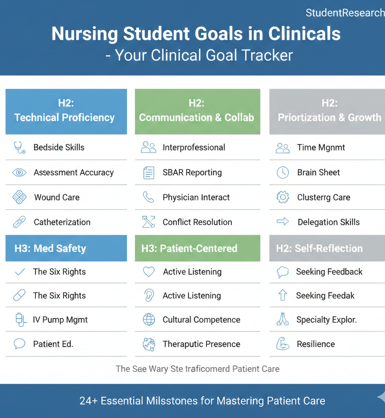
Setting clear objectives allows you to measure your progress and bridge the gap between textbook knowledge and bedside application. Without a roadmap, your clinical hours can easily become a blur of task-oriented chores rather than a structured learning experience. Mastering these goals ensures you maximize your time under the guidance of your preceptor.
Bridging Theory and Practice
- Applying Pathophysiology: Connecting a patient’s diagnosis to the symptoms you observe during your shift.
- Pharmacology Integration: Understanding why a specific medication is ordered rather than just knowing how to administer it.
- Evidence-Based Rationales: Defending your nursing actions based on the latest clinical research and hospital protocols.
Critical Thinking Development
- Prioritization: Learning which patient or task requires your immediate attention when multiple needs arise.
- Anticipating Needs: Looking ahead to what a patient or doctor might need before they ask for it.
- Data Interpretation: Evaluating lab results and vital signs to predict potential complications.
Worried about your digital privacy? StudentResearch.net guarantees absolute confidentiality and privacy protection. With encrypted payment systems and secure data handling, your personal details and orders always remain 100% private. Focus on your clinicals while we handle the rest securely.
Core Nursing Student Goals in Clinicals for Technical Proficiency
Your technical skills are the foundation of your nursing practice, and the clinical setting is the only place to truly refine them. Whether it is starting an IV or performing a sterile dressing change, these hands-on tasks require repeated exposure. Developing nursing student goals in clinicals centered on psychomotor skills will build the muscle memory necessary for your future career.
Mastering Essential Bedside Skills
- Assessment Accuracy: Performing head-to-toe assessments that are both thorough and efficient.
- Wound Care: Demonstrating sterile technique while managing various types of surgical or pressure injuries.
- Catheterization: Practicing the insertion of Foley catheters with a focus on patient comfort and infection control.
Medication Administration and Safety
- The Six Rights: Consistently verifying the right patient, drug, dose, route, time, and documentation.
- IV Pump Management: Setting up primary and secondary infusions and troubleshooting occlusion alarms.
- Patient Education: Explaining the side effects and benefits of medications to patients in simple terms.
Reducing Medical Errors
- Double-Checks: Utilizing the “scanning” system and peer-verification for high-alert medications like insulin or heparin.
- Environment Optimization: Minimizing distractions during the “med pass” to ensure total focus on the task at hand.
Communication and Professional Collaboration
Effective communication is the lifeblood of safe healthcare delivery, serving as the primary bridge between clinical data and patient safety. In the fast-paced hospital environment, learning to communicate with diverse personalities and professional hierarchies is a vital part of your undergraduate education. You must learn to advocate for your patient with clarity while maintaining professional boundaries and mutual respect with your colleagues. Establishing nursing student goals in clinicals that prioritize high-stakes information exchange will prepare you for the intense collaboration required in modern medicine.
Interprofessional Communication
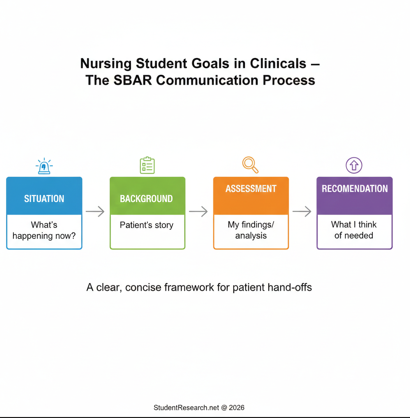
- SBAR Reporting: Utilizing the Situation, Background, Assessment, and Recommendation framework ensures that your hand-offs are concise, structured, and free of irrelevant “fluff.”
Professional SBAR Script Template
- Situation: “Hello, Dr. [Name], this is [Your Name], the nursing student caring for Patient [Name] in Room [Number]. I am calling because the patient is currently experiencing [identify the acute change, e.g., a sudden drop in oxygen saturation to 88% on room air].”
- Background: “The patient was admitted two days ago with [Diagnosis, e.g., post-operative hip replacement]. They have a history of [Relevant History, e.g., COPD] and were stable throughout the morning until ten minutes ago.”
- Assessment: “Currently, the patient’s vitals are [List Vitals]. I hear diminished breath sounds in the bases, and the patient is using accessory muscles to breathe. I believe the patient may be developing [Assessment, e.g., atelectasis or fluid overload].”
- Recommendation: “I recommend that we [Action, e.g., start 2L of oxygen via nasal cannula and order a STAT chest X-ray]. Would you like me to stay with the patient until the respiratory therapist arrives, or is there any other intervention you would like to order now?”
Tips for a Successful Report
- Have the Chart Open: Ensure you have the latest lab results and medication administration record (MAR) in front of you before making the call.
- Vital Signs First: Always take a fresh set of vitals immediately before calling so your data is current.
- Be Direct: State the most concerning fact in the first twenty seconds to grab the provider’s attention.
By utilizing this script, you fulfill one of the most important nursing student goals in clinicals: becoming a competent and confident advocate for your patient.
- Physician Interaction: Gaining the confidence to report urgent changes in patient status to the attending doctor or resident, ensuring you have all pertinent vital signs ready before making the call.
- Conflict Resolution: Navigating disagreements or misunderstandings within the healthcare team professionally by focusing on the patient’s needs rather than personal grievances.
| Communication Type | Student Focus | Professional Goal |
| Verbal Report | Accuracy of raw facts and data | Synthesizing data to drive clinical decisions |
| Documentation | Meeting checklist and flow-sheet requirements | Telling the patient’s “story” for legal and clinical clarity |
| Patient Interaction | Building basic rapport and comfort | Using therapeutic communication to de-escalate crisis |
Patient-Centered Communication
- Active Listening: Giving the patient your full attention to uncover hidden concerns, such as spiritual distress or unmanaged pain, which might not be visible on a monitor.
- Cultural Competence: Respecting and incorporating the patient’s cultural beliefs, dietary restrictions, and modesty preferences into their daily care plan.
- Therapeutic Presence: Learning how to provide silent support and comfort during difficult diagnoses, end-of-life care, or during high-anxiety procedures.
Refining Professional Documentation
- Objective Language: Writing notes that focus on observable data (e.g., “Patient’s skin is cool and clammy”) rather than subjective opinions (e.g., “Patient looks bad”).
- Timely Entry: Developing the habit of documenting assessments immediately to ensure the medical record reflects the most current state of the patient for the entire team.
- Legal Protection: Understanding that “if it wasn’t charted, it wasn’t done,” and ensuring all safety interventions, like bed rails and call lights, are consistently recorded.
By focusing on these nursing student goals in clinicals, you move beyond the “task-list” mentality and begin to see yourself as a vital coordinator of care. Mastering the nuances of how information flows through a unit is often the difference between a chaotic shift and a successful one. As you practice these interactions, you will find that your confidence grows alongside your technical ability.
Prioritization and Time Management Strategies
One of the hardest aspects of nursing is managing the clock when you have multiple patients with competing needs. Learning to organize your day effectively is a cornerstone of nursing student goals in clinicals. As you progress, you should move from managing one patient to successfully overseeing a full “load” with minimal intervention.
Organizing the Clinical Shift
- The “Brain” Sheet: Developing a personalized organization tool to track tasks, meds, and assessments.
- Clustering Care: Performing multiple tasks at once (e.g., vitals, assessment, and med pass) to save time and allow the patient to rest.
- Delegation Skills: Understanding what tasks can be safely delegated to Unlicensed Assistive Personnel (UAP).
Need expert help that fits your budget? StudentResearch.net provides affordable pricing with exclusive student discounts and loyalty rewards. Get high-quality academic assistance without breaking the bank. Join our community today and save big on your first professional order!
Efficient Workflow Habits
- Supplies Prep: Gathering all necessary equipment before entering a patient’s room to avoid repeated trips.
- Chart-as-you-go: Documenting findings immediately after an intervention to ensure accuracy and prevent a backlog at shift change.
To further your nursing student goals in clinicals, use this concise script for a seamless shift-change hand-off.
Shift-Change Hand-off Script
- Situation: “I’m handing off [Patient Name] in 402, admitted for [Diagnosis]. They are currently stable.”
- Background: “History includes [Condition]. They had [Procedure] yesterday with an unremarkable recovery so far.”
- Assessment: “Vitals are stable; the surgical site is clean, dry, and intact. Pain is managed at a 2/10 on Oral Meds.”
- Recommendation: “Continue monitoring output and encourage ambulation this evening. The next dose of IV antibiotics is due at 19:00.”
Self-Reflection and Professional Growth
The most successful nurses are those who never stop learning and who take the time to reflect on their experiences. Your nursing student goals in clinicals should include a commitment to self-assessment and the pursuit of feedback. Embracing your mistakes as learning opportunities is what will eventually lead to mastering the clinical environment.
Seeking and Utilizing Feedback
- Preceptor Check-ins: Asking for a mid-shift evaluation to identify areas for improvement before the day ends.
- Constructive Criticism: Viewing corrections as a tool for safety rather than a personal critique.
- Self-Correction: Identifying your own errors and proactively seeking the correct way to perform the task next time.
Long-Term Career Planning
- Specialty Exploration: Using your rotations to determine if you prefer the pace of the ICU, ER, or Med-Surg.
- Networking: Building relationships with unit managers and staff for future employment opportunities.
- Portfolio Building: Documenting unique procedures or cases you witnessed for your professional portfolio.
Mental and Emotional Resilience
- Stress Management: Identifying healthy ways to decompress after a high-pressure clinical day.
- Boundary Setting: Learning to leave work at the hospital to prevent academic and professional burnout.
Striving for perfection in your assignments? At StudentResearch.net, we offer unlimited free revisions until you are 100% satisfied. Our commitment to quality ensures your essays meet every rubric requirement. Experience total peace of mind with our dedicated expert support.
Conclusion: Achieving Excellence in Patient Care
By intentionally setting and pursuing these nursing student goals in clinicals, you are doing more than just passing a course; you are building the framework for a lifelong career. Remember that clinicals are a safe space to ask questions, make mistakes under supervision, and refine your unique nursing voice. As you continue your journey, keep these 24+ milestones in mind to ensure you are always moving toward professional mastery.
Meta Description: Nursing student goals in clinicals: Discover 24+ essential milestones for mastering patient care, technical skills, and professional communication today.

