

The Importance of Drug Cards in Nursing Clinicals
Walking into a patient’s room for the first time can be overwhelming, but having the right tools in your pocket changes everything. Mastery of pharmacology is often the biggest hurdle for future nurses, requiring extensive student research to ensure accuracy. Utilizing a dedicated drug card template for nursing students transforms a chaotic clinical day into an organized learning experience. These cards serve as your brain’s external hard drive during high-stakes medication passes. By condensing complex data into quick-reference guides, you ensure that safety remains your top priority.
Bridging the Gap Between Theory and Practice
- Translates complex pharmacological concepts from the classroom to real-world patient care.
- Acts as a quick-reference guide during bedside medication administration.
- Helps students apply theoretical knowledge to specific patient scenarios.
Enhancing Memory Retention Through Active Recall
- Forces students to synthesize dense textbook information into a portable, high-yield format.
- Reinforces long-term memory more effectively than passive reading.
- Encourages active engagement with the material during the creation process.
Ensuring Patient Safety at the Bedside
- Allows a student to quickly verify contraindications before administration.
- Facilitates the “rights of medication administration” check.
- Provides a safety net for validation before the instructor arrives.
How Drug Cards Prepare You for the NCLEX
- Standardizes the way you review medications, making study sessions more productive.
- Focuses on high-yield information frequently tested on board exams16.
Identifying Pharmacological Classifications
- Organizing cards by drug class helps students learn to recognize suffix patterns.
- Helps identify common suffixes like -olol (beta-blockers) or -pril (ACE inhibitors).
- Builds a critical skill required for board exam success.
Essential Components of a Drug Card Template for Nursing Students
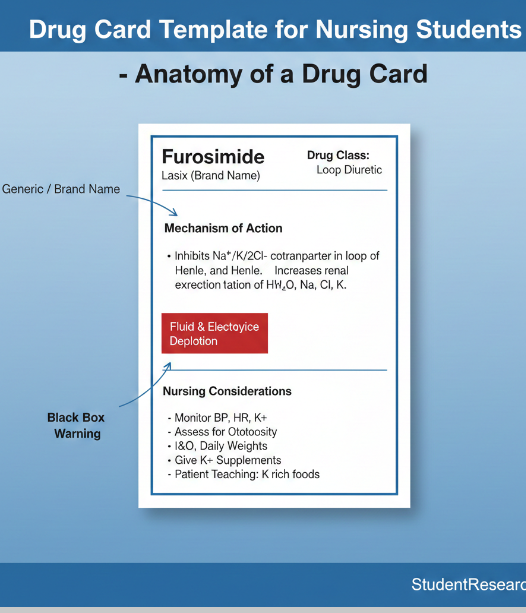
A well-structured drug card template for nursing students must be comprehensive yet concise to be effective. Every template should follow a logical flow that mirrors how a nurse assesses a patient before giving a pill. Including these essential components ensures you never miss a critical piece of safety data.
Core Medication Identification
- Establishes the foundation of the drug’s identity.
- Ensures the student knows exactly what is being administered and why.
Generic vs. Brand Names and Classifications
| Feature | Importance in Nursing |
| Generic Name | The primary identifier used in most exams and hospital systems. |
| Brand Name | Helps identify medications patients may use at home. |
| Drug Class | Groups meds by their physiological effects or chemical structure. |
Clinical Indicators and Mechanisms
- Provides the rationale for the medication’s use.
- Connects the drug to the patient’s specific diagnosis.
Indications and Therapeutic Action
- Explains what the drug is for (Indications).
- Explains the “why” behind its mechanism of action (MOA) within the body.
- Helps the nurse understand the expected outcome of the therapy.
Safety Data and Nursing Implications
- Lists the dangers and monitoring requirements for the drug.
- Forms the basis for patient education and monitoring plans.
Side Effects vs. Adverse Reactions
| Category | Description and Examples |
| Side Effects | Common, often expected reactions such as nausea or dry mouth. |
| Adverse Reactions | Life-threatening or severe reactions like angioedema or anaphylaxis. |
| Nursing Priority | Distinguishing between the two helps prioritize nursing interventions. |
Critical Nursing Considerations and Patient Teaching
- Focuses on what the nurse must assess, such as an apical pulse or blood pressure, before giving the med.
- Outlines what the patient needs to know for safe home care.
- Highlights dietary restrictions or specific timing for doses.
7 Powerful Tips to Create Effective Drug Cards
Efficiency is key when you are juggling multiple clinical rotations and heavy course loads. These tips will help you refine your drug card template for nursing students to make it more professional424242. Implementing these strategies will save you time and improve your clinical performance.
Maximizing Efficiency and Clarity
- Reduces the time spent searching for info during a med pass.
- Improves the readability of the card under pressure.
1. Use Color-Coding for Drug Classes
- Assigning specific colors (e.g., red for high-alert meds like insulin) helps the brain categorize info.
- Increases speed of recognition during high-stress clinical rotations.
2. Utilize Standardized Abbreviations
- Save space by using “AE” for adverse effects.
- Use “NTE” for “not to exceed” to keep cards readable at a glance.
3. Focus on “Must-Know” Black Box Warnings
- Highlighting FDA black box warnings ensures critical safety info is never missed.
- Acts as a major red flag during the medication administration process.
Advanced Study Techniques
- Elevates your cards from simple notes to clinical decision-making tools.
- Aligns your studying with the professional nursing process.
4. Incorporate the Nursing Process (ADPIE)
- Structure “Nursing Considerations” to follow Assessment, Diagnosis, Planning, Implementation, and Evaluation.
- Ensures a holistic approach to medication management.
5. Keep it Concise with Bullet Points
- Avoid full sentences to allow for quick scanning.
- The best cards use fragments and keywords for maximum clarity.
6. Include Lab Values to Monitor
- Specify non-negotiable labs, such as INR for Warfarin.
- Note Potassium levels for patients taking Furosemide.
7. Leave Space for “Clinical Pearls”
- Add a small section for floor-learned tips, like “administer with food to decrease GI upset”.
- Captures experiential knowledge that textbooks might miss
Struggling to balance your budget and your grades? At StudentResearch.net, we offer premium academic support with affordable pricing and exclusive student discounts. Get professional help that fits your wallet—perfect for your first order or loyal returns
Digital vs. Handwritten Drug Cards: Which is Better?
Choosing the right medium for your drug card template for nursing students depends on your personal learning style626262.
| Feature | Handwritten Cards | Digital Templates |
| Retention | Higher memory retention due to kinesthetic learning. | Lower; typing is often more passive. |
| Portability | Can be bulky if you have many cards. | Easy to store on a phone or tablet. |
| Editing | Hard to change; usually requires a new card. | Fast updates and easy searchability. |
The Case for Hand-Written Cards
- Provides a tactile experience that aids in memorization.
- Easier to use in clinical settings where tablets might not be allowed.
The Kinesthetic Learning Advantage
- The physical act of writing translates info from short-term to long-term memory.
- Often the preferred method for complex pharmacology topics.
The Benefits of Digital Templates
- Allows for infinite backups and easy sharing with peers.
- Can include hyperlinks to drug databases for deeper research.
Searchability and Easy Updates
- Tools like Word or Canva allow for quick keyword searches.
- Allows students to edit information as they progress through different semesters.
Step-by-Step Guide to Using Your Template
Mastering the use of your drug card template for nursing students requires a consistent routine. Consistency in how you prepare will directly impact your confidence on the floor. Use these steps to integrate your cards into your daily clinical workflow.
Preparing Before Your Clinical Shift
- Reduces stress on the morning of your shift.
- Ensures you are fully prepared for instructor questioning.
Researching Patient-Specific Medications
- Use your template to pre-fill cards for assigned medications the night before clinical.
- Tailor the info to your specific patient’s comorbidities and labs.
Evaluation and Revision
- Ensures your knowledge remains up-to-date with current practice.
- Helps you grow from a student into a competent professional.
Updating Cards Based on Instructor Feedback
- Use post-conference “pearls” to refine your cards for future use.
- Gain confidence with our drug card template for nursing students. This guide offers 7 powerful tips to simplify pharmacology and ace your clinicals.
Need more than just a drug card? From complex dissertations and case studies to lab reports and essays, StudentResearch.net provides a wide range of academic services. Let our experts handle your toughest assignments while you focus on clinicals.

