

Navigating the complexities of pharmacology is often the most significant challenge a nursing student faces during their academic journey. Success in this demanding subject requires more than just memorization; it demands a highly organized system to manage vast amounts of data. By utilizing a nursing student printable drug card template, you can transform overwhelming textbook chapters into concise, actionable study tools. Extensive student research suggests that active engagement with material through physical writing significantly enhances long-term retention. Your own student research will soon demonstrate that having these structured cards at your fingertips during clinical rotations is a game-changer for safety and confidence. This guide explores 17 essential tools to help you master medications and provide exceptional patient care.
Understanding the Role of Pharmacology Organization in Nursing School
Organizing your pharmacology studies is not merely a preference but a professional necessity for safe practice. A structured approach allows you to categorize medications by class, making it easier to identify patterns and critical safety alerts. Without organization, the risk of confusion and medication errors increases significantly during high-stakes clinical shifts. Implementing a systematic method early on establishes a foundation for lifelong clinical excellence and patient safety.
Why is a Nursing Student Printable Drug Card Template Important?
- Standardized Structure: Provides a consistent layout for every drug, ensuring no critical data point is overlooked12.
- Tactile Learning: Engaging in the physical act of writing aids in the cognitive encoding of complex information13.
- Clinical Readiness: Offers a portable, quick-reference tool that fits easily into scrub pockets for bedside verification14.
- Focused Study: Forces you to synthesize lengthy textbook descriptions into the most relevant clinical “must-knows”15.
How to improve retention using visual learning for complex mechanisms.
Essential Tool #1
- Consistent Formatting: Use the same visual location on every card for the “Mechanism of Action” to build mental spatial memory.
- Integrated Diagrams: Sketch small, simple receptor-site icons next to the drug’s action to create a visual anchor.
- High-Contrast Emphasis: Use bolding or underlining within the template to highlight the primary physiological impact of the medication.
- Symbolic Short-hand: Use universal symbols (like an upward arrow for “increased heart rate”) to simplify complex textual explanations visually.
Reasons for using physical cards to prevent medication errors in clinicals.
Essential Tool #2:
- Zero Battery Dependency: Physical cards are always accessible, unlike digital devices that may lose charge or signal in hospital “dead zones”.
- Distraction-Free Reference: Using a paper card eliminates the risk of phone notifications interrupting your critical medication-checking process.
- Point-of-Care Verification: Allows for a direct physical comparison between the drug label and your pre-vetted medication data at the bedside.
- Collaborative Review: Easily shared with a preceptor or fellow student to double-check dosages or indications before administration.
Benefits of handwriting for memory compared to digital typing.
Essential Tool #3:
- Deep Cognitive Encoding: Handwriting requires more mental effort than typing, which leads to better long-term memory retrieval.
- Information Synthesis: The limited space on a card forces you to rephrase and summarize information in your own words.
- Reduced Passive Learning: Typing often becomes a mindless “copy-paste” action, whereas writing keeps the brain actively engaged with the content.
- Personalized Emphasis: Allows for unique shorthand, circling, and margin notes that reflect your personal learning style and priorities.
Essential Components of a Nursing Student Printable Drug Card Template
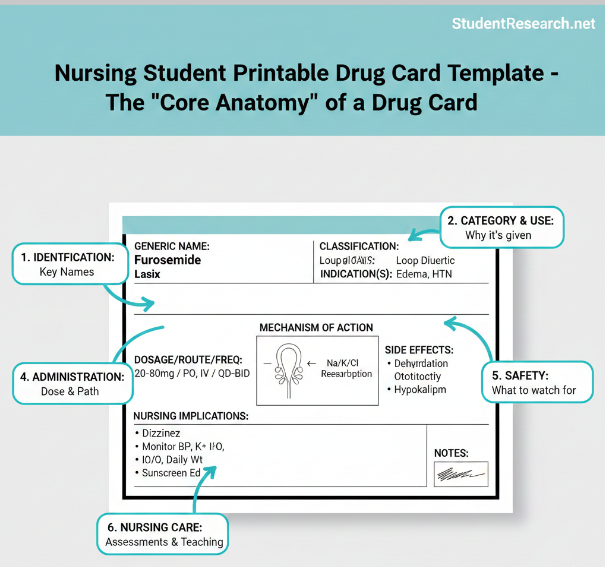
A comprehensive template serves as a roadmap for safe medication administration and patient advocacy. By including specific, high-yield fields, you ensure that every card you create is a complete and reliable clinical resource. This structured data collection is vital for accurate identification and assessment in real-world nursing scenarios.
What is included in a comprehensive drug card?
- Drug Names: Clearly labeled sections for both generic and brand names.
- Classifications: The therapeutic and pharmacologic classes of the medication.
- Clinical Indications: The specific reasons why the patient is receiving the drug.
- Dosage & Administration: Safe ranges, standard routes, and administration timing.
- Safety Alerts: Prominent areas for contraindications and “Black Box” warnings.
- Nursing Implications: Required assessments, lab monitoring, and patient teaching points.
Defining generic and brand names for accurate drug identification.
Essential Tool #4
- Generic Centricity: List the generic name prominently, as this is the standard used for NCLEX and most hospital systems.
- Common Brand Aliases: Include well-known brand names to help identify medications during shift reports or when reviewing older records.
- LASA Identification: Note if the drug is on the “Look-Alike, Sound-Alike” list to trigger extra caution during administration.
- Tall Man Lettering: Incorporate standardized lettering (e.g., DOBUTamine vs. DOPamine) within your template to visually differentiate similar-looking names.
Classification and indications: Understanding why the drug is prescribed.
Essential Tool #5:
- Pharmacologic Class: Detail the exact mechanism, such as “Beta-Blocker,” to understand how the drug affects the body.
- Therapeutic Class: Identify the broad goal, like “Antihypertensive,” to know the intended outcome for the patient.
- FDA-Approved Uses: List the primary reasons for prescribing the drug based on clinical standards.
- Common Off-Label Uses: Note frequent non-FDA approved uses you might encounter, such as using certain antidepressants for chronic pain.
Examples of safe dosage ranges and administration routes.
Essential Tool #6
- Adult Dose Ranges: Document the typical therapeutic range to quickly recognize a potential dosing error.
- Route Variations: Specify how dosages might differ between oral (PO), intravenous (IV), and intramuscular (IM) routes
- Ceiling Dosages: Mark the absolute maximum dose allowed in 24 hours to prevent toxicity and adverse events.
- Infusion Specifics: For IV meds, include “IV Push” rates or “Piggyback” infusion times to ensure safe administration speed.
How to Master Pharmacology Using Your Printable Drug Cards
Mastery of pharmacology requires moving beyond static reading into the realm of active study and repetition. By using your templates as dynamic tools, you can ensure that drug knowledge moves from short-term to long-term memory.
Steps to achieve mastery through active recall and spaced repetition
- Initial Drafting: Summarize drug information into the template immediately after a lecture.
- Self-Testing: Cover sections of the card and attempt to state the information from memory.
- Scheduled Reviews: Revisit your drug cards at intervals (1 day, 3 days, 1 week) to reinforce the knowledge.
- Group Comparison: Compare cards within the same class to identify commonalities and unique differences.
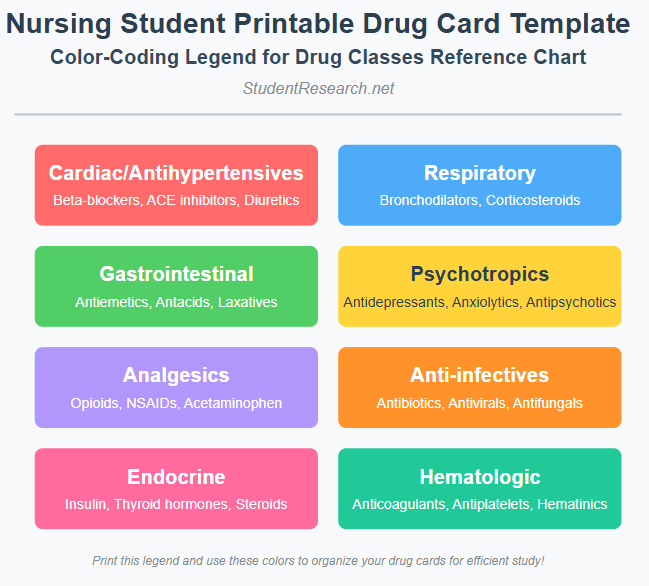
Ways to color-code cards by drug class to identify patterns.
Essential Tool #7
- System-Based Colors: Assign a specific card or border color for each body system (e.g., Pink for OB, Blue for Cardiac)
- Suffix Highlighting: Use a consistent color to highlight common endings like “-pril” or “-sartan” to instantly recognize drug families.
- Warning Indicators: Use a bold red highlighter for “High-Alert” medications to signal the need for extreme caution
- Therapeutic Goal Coding: Color-code by the drug’s primary action, such as green for “Go/Stimulants” and purple for “Slow/Depressants”.
Guide to creating “Daily Five” sets for manageable study sessions.
Essential Tool #8:
- Morning Selection: Choose five drug cards each day that are most relevant to your current clinical or classroom focus.
- Frequent Exposure: Keep these five cards with you at all times, reviewing them during transit, meals, or short breaks.
- Peer Quizzing: Use your “Daily Five” to quiz classmates, explaining the core concepts of each drug out loud.
- Progress Tracking: Only rotate a card out of the “Daily Five” once you can recall all its key points perfectly.
Learning the “Blank Side” method for testing mechanism of action.
Essential Tool #9:
- Reverse Identification: Look at the clinical indications and try to name the specific drug written on the other side.
- Visual Sketching: Use the blank back of the card to draw the receptor site or physiological pathway from memory.
- Scenario Writing: Write a short patient symptom on the blank side and list which drug from your card set is the correct intervention.
- Oral Defense: Explain the drug’s mechanism to an imaginary patient using only the blank side of the card as a prompt.
Guide to Integrating Drug Cards into Your Clinical Prep
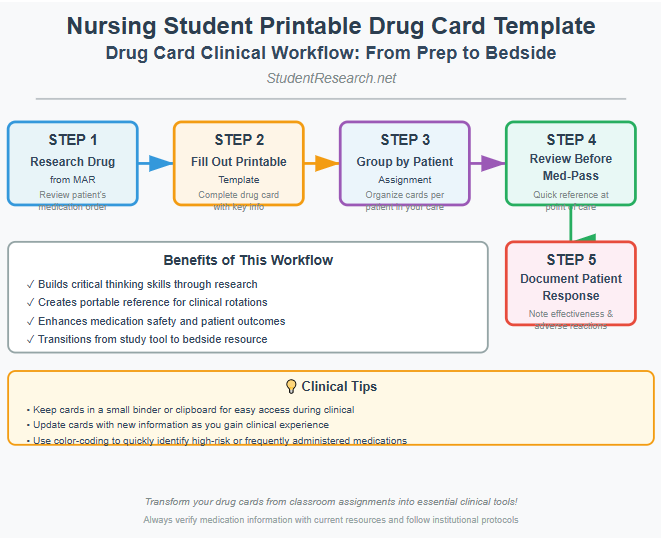
Transitioning your study cards into clinical tools is where theoretical knowledge meets actual patient safety. This integration ensures that the information you’ve meticulously organized is ready when you need it most at the bedside. These templates become an essential part of your clinical toolkit, streamlining your preparation and care delivery.
Practical illustrations of streamlining patient care with templates
- Pre-Shift Mapping: Matching your drug cards to your assigned patient’s medication list the night before clinical.
- Pocket Reference: Carrying active patient medications on a ring for instant verification during med passes.
- Patient Education: Using the “Patient Teaching” section of your card to guide your bedside explanations.
- Post-Administration Monitoring: Quickly checking your card for specific side effects to look for after giving a dose.
H4 How do I organize cards by patient assignment to anticipate side effects?
Essential Tool #10
- Patient-Specific Rings: Group all cards for “Patient A” on one binder ring to maintain a clear medication profile for each individual.
- Time-Based Sorting: Arrange the cards in the order the medications are due (e.g., 0900 meds first) to stay ahead of your shift.
- Adverse Effect Highlighting: Specifically review the “Side Effects” section for the drugs in your patient’s set before you start your shift.
- Assessment Alignment: Match the side effects on your cards to the specific physical assessments you must perform for that patient.
Understanding “Black Box Warnings” for high-alert medication safety.
Essential Tool #11
- Prominent Placement: Use a dedicated, bolded section in your template specifically for “Black Box Warnings” so they are never missed78.
- Risk Categorization: Clearly label the warning type, such as “Severe Bleeding Risk” or “Suicidal Ideation,” for immediate awareness79.
- Monitoring Mandates: List the specific nursing actions required by the warning, such as continuous EKG monitoring or frequent neuro checks80.
- Safety Verification: Include a checkbox for “Second RN Witness” if the drug is a high-alert medication requiring dual verification81.
Nursing implications explained: Monitoring vital signs and lab values.
Essential Tool #12
- Vital Sign Parameters: Clearly state “Hold” parameters, such as “Hold if Systolic BP < 100” for antihypertensives.
- Pre-Dose Lab Checks: List necessary labs to verify before administration, such as checking Potassium levels before giving Lasix.
- Post-Administration Monitoring: Note which vital signs need re-checking after the drug is given to evaluate for therapeutic or adverse effects.
- Trough and Peak Times: Document when to draw lab levels for drugs with narrow therapeutic windows, like Vancomycin.
Difference Between Digital and Printable Drug Card Formats
Choosing the right format for your drug cards depends on your unique learning style and the demands of your clinical environment. While technology offers speed, physical templates provide unique cognitive and practical advantages in the nursing world.
| Feature | Digital Drug Cards (Apps/Software) | Printable Drug Card Templates |
| Accessibility | Instant search, but requires battery/Wi-Fi. | No power needed; accessible anywhere, anytime. |
| Retention | Often lower due to passive typing/reading. | Higher due to active handwriting and tactile engagement. |
| Professionalism | May look like “playing on a phone” to patients. | Viewed as a professional, dedicated clinical tool. |
| Flexibility | Limited to the app’s predefined fields. | Fully customizable for specific clinical needs. |
Which option is better for your specific learning style?
For most nursing students, I recommend the printable drug card template as the primary tool for mastery, as the act of physical writing is unmatched for long-term clinical retention.
Benefits of the kinesthetic approach for visual learners.
Essential Tool #13
- Muscle Memory: The physical movement of writing helps solidify drug names and dosages in your mind.
- Visual Ownership: Seeing your own handwriting and specific layout creates a unique mental map that is easier to recall during exams.
- Spatial Awareness: Arranging cards physically on a desk allows visual learners to see relationships between drug classes more clearly.
- Tangible Achievement: Physically seeing a growing stack of completed cards provides a psychological boost and a clear sense of progress.
Comparing the portability of printables vs. heavy textbooks.
Essential Tool #14
| Aspect | Pharmacology Textbooks | Printable Drug Cards |
| Weight | Often 5-8 lbs; cumbersome to carry. | Lightweight; fits in a pocket or clipboard. |
| Searchability | Requires flipping through indices and chapters. | Instant access to a specific, pre-vetted drug. |
| Clinical Utility | Impractical for use at the patient’s bedside. | Designed specifically for rapid point-of-care use. |
| Focus | Contains excessive background theory. | Highlights only the critical “need-to-know” data. |
Using printables as a “Brain Dump” sheet for process-oriented exams.
Essential Tool #15
- Mental Blueprinting: Practice filling out a blank template from memory to prepare for complex pharmacology exam questions.
- Logical Structuring: Use the template’s categories (Assessment, Implementation, Evaluation) to organize your thoughts for nursing process questions.
- Stress Management: Having a familiar visual structure helps reduce anxiety when you face a drug you don’t immediately recognize.
- Pattern Recognition: Use the “Brain Dump” to list all drugs in a class to ensure you understand their common nursing implications.
Your privacy is our priority! At StudentResearch.net, we guarantee 100% confidentiality for every order
. Our secure payment systems and advanced data encryption ensure your personal information remains protected while you receive top-tier academic assistance.
Where to Find and Customize the Best Templates
Finding a reliable nursing student printable drug card template is the first step toward pharmacology success. Selecting a template that matches your learning style and course requirements will save you hours of preparation time.
Types of nursing student printable drug card template resources
- Academic Portals: Many nursing programs provide standard templates through their learning management systems (e.g., Canvas, Moodle).
- Educational Blogs: Nursing-focused websites often offer free, high-quality PDF downloads for students.
- Customizable Design Apps: Tools like Canva allow you to create or modify templates to fit your specific needs.
- E-Commerce Specialty Shops: Platforms like Etsy offer professionally designed templates tailored to specific nursing specialties.
How to find high-quality PDF templates with clean layouts.
Essential Tool #16
- Prioritize Clarity: Look for templates with ample white space and clear borders to ensure your handwriting remains legible.
- Check for Essential Fields: A high-quality template must include dedicated sections for Mechanism of Action, Nursing Considerations, and Labs.
- Verify Print Size: Ensure the PDF is formatted for standard US Letter (8.5 x 11) or 4×6 index card sizes for easy printing and portability.
- Seek Fillable Features: Some PDFs are “fillable,” allowing you to type your student research before printing if you prefer a cleaner, typed look.
- Look for Multiple Designs: Choose a source that offers variations (e.g., vertical vs. horizontal) so you can find what fits your storage system (like a binder or ring).
- Review Student Feedback: Check reviews or comments to see if other nursing students find the layout practical for real-world clinical use.
Ways to customize templates for Pediatrics or OB specialties.
Essential Tool #17
- Weight-Based Dosing Fields: Add a specific area for mg/kg calculations, which are critical in pediatric pharmacology.
- Teratogenic Safety Alerts: Include a prominent section for Pregnancy Categories (A, B, C, D, X) or Lactation safety in OB templates.
- Developmental Considerations: Add a field for “Age-Appropriate Administration” to note differences for infants versus adolescents.
- Fetal Impact Monitoring: For labor and delivery drugs, include space to document the drug’s effect on fetal heart rate patterns.
- Specific Antidotes: Highlight specific reversal agents (e.g., Vitamin K for newborns) in a high-visibility color.
- System-Specific Labs: Add fields for specialty-specific lab monitoring, such as bilirubin levels in neonates or magnesium levels in pre-eclampsia patients.
Conclusion
Mastering pharmacology is a cornerstone of becoming a safe and effective nurse. By leveraging these 17 essential tools, you can move from feeling overwhelmed to feeling empowered. Learn how a nursing student printable drug card template simplifies pharmacology. Use these 17 vital tools to master medications and pass clinicals. Whether you are organizing by body system or customizing for a specialty rotation, the right template ensures your knowledge is structured, accessible, and clinically relevant. Start building your drug card library today and watch your confidence and clinical performance soar.
Worried about your budget? StudentResearch.net offers competitive rates and exclusive first-time user discounts tailored for nursing students
. Benefit from our loyalty programs and seasonal promotions to get high-quality academic support that fits your wallet.

