

Entering the clinical environment requires precision, and finding good watches for nursing students is a critical step in professional preparation. Detailed student research is essential to ensure a timepiece meets strict hospital standards while surviving the rigors of a 12-hour shift. Through thorough student research, you can find a reliable tool that simplifies complex tasks like medication timing and vital sign documentation.
- The Clinical Reality: While smartphones are found everywhere, they act as “fomites” or infection carriers and are frequently banned in active clinical settings.
- The “Second” Rule: Having a visible second hand or digital seconds display is non-negotiable for accurately timing medications and charting patient vitals.
- The Transition: Utilizing the right gear helps ease the transition from the high stress of nursing school lectures to the fast-paced demands of hands-on patient care.
Why a Reliable Watch is a Nursing Necessity:
- Infection Control: It allows you to check the time without touching a contaminated phone.
- Precision: It ensures exactness during manual pulse and respiratory rate assessments.
- Professionalism: It keeps you on track for medication passes and rounding schedules.
- Compliance: It adheres to clinical site policies that prohibit personal mobile device use.
Buying Guide: Features of the Best Medical Watches for Nursing Students
Selecting the ideal timepiece requires a balance between clinical utility and long-term durability. This guide highlights the essential features of the best medical watches for nursing students to ensure your investment stands up to the demands of the hospital floor.
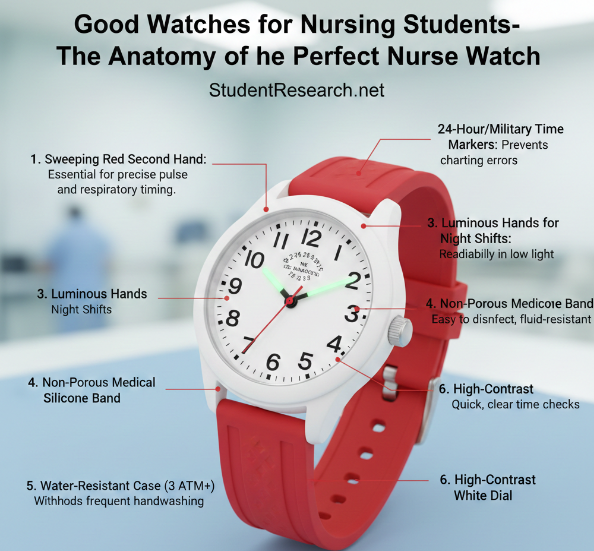
- Fluid Resistance: Must withstand frequent exposure to water, soap, and chemical disinfectants.
- High Contrast: A clear dial that is readable in the dim lighting of a patient’s room at night.
- Ease of Sanitization: Smooth surfaces and non-porous bands that don’t harbor pathogens.
- 24-Hour Marking: Crucial for students learning to document in military time without errors.
Analog vs. Digital: Which is Better for Clinicals?
The “Gold Standard” for any clinical rotation is a watch that features either a 3-hand analog face or a clear 24-hour digital display.
The Case for Analog: Why a red sweeping second hand is superior for rapid pulse and respiratory checks.
- Visual Tracking: A red sweeping hand provides a distinct visual cue that is easier to follow while counting heartbeats.
- No Buttons Required: Allows for “hands-free” timing; you simply glance at the dial while keeping both hands on the patient or equipment.
- Mental Subdivisions: Analog faces allow you to easily visualize 15-second or 30-second intervals for quick math.
The Digital Edge: Benefits of 24-hour (Military Time) toggles for accurate medical charting.
- Chart Accuracy: Direct correlation between the watch display and the 24-hour clock used in electronic health records (EHR).
- Reduced Cognitive Load: Eliminates the need to mentally add 12 hours during high-stress situations or late-night shifts.
The Top 5 Analog Picks: Best Medical Watches with Second Hands
Analog timepieces remain the industry favorite because they don’t require battery charging and allow for “hands-free” vitals tracking. When searching for the best medical watches for nursing students, these five models consistently top the charts.
- Speidel Original Scrub Watch: The undisputed gold standard with a high-contrast white dial and red sweeping second hand.
- VAVC Nurse Watch: A premium medical-grade option featuring surgical-grade stainless steel.
- Timex Expedition Acadia: Known for its rugged durability and Indiglo® backlight.
- Nurse Mates Uni-Watch: Specifically designed with a large 1.5-inch case for low-light environments.
- Casio LRW200H: A compact, “dive-inspired” watch that offers 100M water resistance.
Why Speidel Dominates the Nursing Market
Speidel has built a legacy around “Scrub” watches that address the specific pain points of clinical rotations.
The 15-Second Pulse Hack: How to use an analog face to quickly calculate heart rates.
- Quadrant Timing: Counting beats for 15 seconds and multiplying by 4 to get the heart rate per minute.
- Visual Aid: The red second hand stands out against the white dial, making it easier to track the exact start and end points of your count.
Pulsometer Dials: How specialized “Scrub 30” versions allow you to calculate heart rate in 15 seconds.
- Direct Calculation: Some models feature a “Pulsometer” scale. You stop counting after 30 beats, and the hand points directly to the BPM on the scale.
The Top 5 Digital & Sport Watches: Durability Meets Data
For students who prefer numerical accuracy, digital watches offer robust tools like alarms for medication passes.
- Casio G-Shock (S-Series): The “indestructible” choice that survives any trauma bay.
- Timex Ironman Classic 30: Features a 30-lap memory and legendary reliability.
- Armitron Sport: The best value-per-dollar digital watch with a dedicated “Seconds” display.
- Casio F91W-1: A lightweight, low-profile classic that won’t snag on PPE or gloves.
- Nixon The Regulus: Professional-grade shock absorption and dual chronographs.
Essential Digital Tools for Student Charting
Digital watches provide data consistency that helps students stay organized during long shifts.
H4: Military Time (24-Hour Clock): Why digital watches help students avoid charting errors.
- Standardization: Most hospitals operate on a 24-hour clock to prevent “AM/PM” confusion.
- Error Prevention: Seeing “16:00” on your wrist makes it impossible to accidentally chart a 4:00 PM medication as 4:00 AM.
H2: 5. Top 5 Smartwatches: Productivity for Modern Clinicians
Smartwatches are becoming a staple for students who want access to drug reference apps and health tracking.
- Apple Watch Series 10/SE: Seamless integration with drug reference apps like Epocrates.
- Garmin Venu 3S: Superior battery life (up to 10 days) for students who forget to charge nightly.
- Samsung Galaxy Watch 6: The best companion for Android-using students.
- Fitbit Versa 4: A focus on “Body Battery” and recovery tracking.
- Withings ScanWatch: A hybrid design that tracks health data behind an analog face.
Balancing Tech with Hospital Policy
The greatest challenge with smartwatches is navigating school regulations.
Managing Notifications: How to silence “distraction” while keeping “vital” alerts.
- Theater Mode: Crucial for rounds; it prevents your wrist from lighting up or buzzing during patient care.
- Selective Alerts: Set your watch to only vibrate for emergency calls or medication reminders.
Comparative Analysis: Speidel vs. Smartwatches for Clinicals
Deciding between a traditional analog and a smartwatch is a pivotal choice for any student.
- The Policy Gap: Many nursing programs ban smartwatches during exams to prevent cheating.
- The “Fomite” Factor: A silicone Speidel watch is a “single-piece” design that is exceptionally easy to wipe down.
- Reliability: Traditional watches rely on long-lasting batteries, whereas a smartwatch might die mid-shift.
Concerned about academic integrity? Get 100% original content created from scratch, backed by detailed plagiarism reports. StudentResearch.net guarantees unique papers that safeguard your reputation, addressing your primary concerns about authenticity and quality. Your academic future is safe with us!
Choosing Based on Your Nursing Specialty
Critical Care vs. Pediatrics: Which watch styles are safer for different patient populations.
- Critical Care: High-durability digital watches are best for frequent, rapid vitals.
- Pediatrics: Soft, rounded silicone watches (like Speidel) are safer as they lack sharp edges that could scratch an infant.
Maintenance: How to Disinfect and Protect Your Investment
Proper maintenance ensures your watch stays “clinical grade” and pathogen-free.
- Deep Cleaning: Use 70% isopropyl alcohol for quick wipes between patients.
- Band Longevity: Replace silicone straps if you notice:
- Visible cracks in the material.
- Persistent odors that don’t wash away.
- Discoloration from bodily fluids.
Protecting Your Screen from Scratches
Sapphire vs. Mineral Crystal: Which glass type survives bumping into metal hospital bed rails.
| Feature | Sapphire Crystal | Hardened Mineral Glass |
| Durability | Virtually scratch-proof | Scratch-resistant |
| Impact | May shatter under extreme force | More flexible; less likely to shatter |
| Clarity | High clarity | Good clarity, but can dull |
Budget-Friendly Hacks: Getting the Best Price as a Student
You don’t need a professional’s salary to afford a professional’s watch. Many companies offer significant discounts for medical students.
- How to use ID.me or SheerID:
- Create an account on the verification platform.
- Upload a copy of your student ID or acceptance letter.
- Look for the “Verify” button at checkout on major brand sites.
Amazon vs. Direct-to-Consumer
Avoiding Counterfeits: Why buying from authorized retailers matters for warranty claims.
- Warranty Protection: Authorized retailers guarantee the manufacturer will honor repairs.
- Authentic Materials: Ensures you are getting 100% medical-grade silicone.
Struggling with complex clinical assignments? Trust our degree-holding professionals to deliver high-quality, specialized papers across all academic fields. At StudentResearch.net, we prioritize subject matter expertise and academic rigor to ensure your success. Experience true nursing-grade excellence today!
Conclusion: Choosing the Right Companion for Your Career
Finding good watches for nursing students is about more than just checking the time; it’s about choosing a tool that supports your clinical accuracy and patient safety. Find the good watches for nursing students with our top 15 list. Compare analog, digital, and smartwatches for clinical success and durability.
As you embark on the exhausting but rewarding journey of nursing school, remember that every detail—down to the second hand on your wrist—contributes to your success.

