

Why Skills for Nursing Student Resume Matter in Today’s Job Market
The modern healthcare landscape is more competitive than ever, with a growing number of graduates vying for residency programs and entry-level positions. While the demand for nurses remains high, employers are increasingly selective, making the specific skills for nursing student resume inclusion a critical factor in landing an interview. Recent student research indicates that hiring managers spend only seconds scanning a CV; therefore, your ability to highlight specialized competencies is paramount. Further student research highlights that those who successfully bridge the gap between academic theory and clinical application stand out most to recruiters.
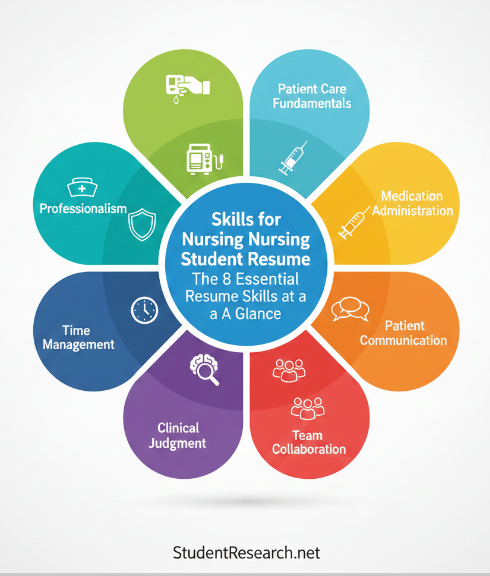
This guide explores eight essential clinical, communication, and critical thinking abilities designed to elevate your professional profile. By following these actionable resume optimization strategies, you can transform your academic background into a compelling narrative of professional readiness.
Why your resume skills are vital for success:
- Stand out in a crowded field: Differentiates your application from hundreds of other new graduates.
- Pass Applicant Tracking Systems (ATS): Ensures your resume contains the keywords healthcare recruiters are searching for.
- Demonstrate clinical readiness: Proves you possess the foundational hands-on abilities required for immediate patient care.
- Highlight “soft skills”: Showcases the interpersonal emotional intelligence that is often as valued as technical proficiency.
- Bridge the experience gap: Uses specific skill sets to compensate for a lack of long-term professional work history.
Struggling to secure those top-tier marks? Elevate your grade profile with professional assistance from StudentResearch.net. Our primary goal is to craft high-quality work that earns you the elite results you need to succeed.
Types of Clinical Skills Every Nursing Student Resume Needs
Clinical skills form the backbone of your nursing application, serving as tangible evidence of your hands-on competency in a healthcare setting. Employers look for a blend of foundational care, technical proficiency, and a commitment to safety protocols.
Essential clinical skill categories for your resume include:
- Direct Patient Care: Foundational tasks that ensure patient comfort and physiological monitoring.
- Technical Procedures: Specific medical interventions such as wound care or catheterization.
- Technological Proficiency: Experience with Electronic Health Records (EHR) and diagnostic machinery.
- Pharmacological Accuracy: Safe medication administration and dosage calculations.
Skill #1: What Is Patient Care Fundamentals and Why Include It
Patient care fundamentals encompass the essential daily tasks required to maintain patient health, hygiene, and dignity. Including these on your resume is vital because:
- Demonstrates Core Competency: Shows you have mastered the “bread and butter” of nursing, such as taking vital signs and monitoring patient stability.
- Reflects Safety Awareness: Highlights your ability to assist with patient hygiene and mobility safely, reducing the risk of falls or pressure ulcers.
- Establishes Reliability: Proves to recruiters that you can handle the high-volume, repetitive tasks essential to ward management.
Examples of Clinical Procedures to List
- Urinary Catheterization: Insertion and maintenance of indwelling and straight catheters.
- Wound Care: Performing sterile dressing changes and monitoring site healing.
- Specimen Collection: Correct procedures for obtaining blood, urine, or stool samples.
- Infection Control: Strict adherence to sterile fields and PPE protocols.
How to Showcase Documentation Skills
- Charting Proficiency: Mention your ability to provide clear, concise, and objective narrative notes.
- EHR System Experience: List specific software you have used, such as Epic or Cerner, to demonstrate technological literacy.
Skill #2: Medical Equipment Proficiency Explained
Modern nursing requires a high degree of comfort with various diagnostic and therapeutic technologies. Mastery of medical equipment ensures that you can provide efficient care while minimizing technical errors in high-pressure environments.
Types of Medical Equipment to Include
- Infusion Tools: IV pumps and PCA (Patient-Controlled Analgesia) machines.
- Monitoring Systems: Cardiac monitors, pulse oximeters, and automated blood pressure machines.
- Diagnostic Tools: Glucometers for blood sugar testing and bladder scanners.
Ways to Demonstrate Safety Protocol Knowledge
- Equipment Maintenance: Understanding the proper cleaning and calibration requirements for floor devices.
- Hazard Awareness: Knowledge of electrical safety and the correct handling of sharps or biohazardous materials.
Skill #3: Steps to Highlight Medication Administration Skills
Medication administration is one of the most critical responsibilities for any nurse. To showcase your competency, you must emphasize your commitment to the “Five Rights” (Right Patient, Right Drug, Right Dose, Right Route, and Right Time) to ensure patient safety.
How to Show Dosage Calculation Competency
- Mathematical Accuracy: Highlight your ability to perform complex calculations for IV drip rates and pediatric dosing.
- Double-Check Protocols: Mention your experience in following hospital policies for high-alert medication verification.
Examples of Pharmacology Knowledge
- Drug Classifications: Recognition of various medication classes, such as anticoagulants, antibiotics, and analgesics.
- Adverse Effects: Ability to identify and respond to common side effects or allergic reactions.
Guide to Communication Skills for Nursing Student Resumes
Effective communication is the cornerstone of safe and compassionate healthcare delivery. Beyond technical tasks, your ability to exchange information accurately with patients and colleagues is a top priority for hiring managers.
Skill #4: Benefits of Patient Communication and Empathy Skills
Mastering interpersonal interactions directly impacts patient outcomes and satisfaction scores. Highlighting these benefits on your resume proves you value the human element of nursing4:
- Active Listening: Demonstrates your ability to fully concentrate and understand patient concerns before responding.
- Compassionate Care: Shows a commitment to treating patients with dignity and emotional support during vulnerable moments.
- Improved Compliance: Good communication helps patients better understand their treatment plans, leading to better health results.
Types of Therapeutic Communication Techniques
- Open-Ended Questions: Using prompts that encourage patients to share detailed information rather than simple “yes” or “no” answers.
- Validation and Reflection: Utilizing methods that acknowledge a patient’s feelings and mirror their statements to ensure mutual understanding.
Understanding Cultural Competence in Nursing
- Diverse Populations: Maintaining sensitivity to various religious, ethnic, and socioeconomic backgrounds.
- Inclusive Care: Adapting communication styles to meet the unique needs of diverse patient groups.
Skill #5: How to Demonstrate Team Collaboration on Your Resume (H3)
Nursing is a team sport that requires seamless integration with doctors, therapists, and other staff Showcasing your collaborative nature proves you can thrive in an interdisciplinary environment
What Is SBAR and Why It Matters
SBAR (Situation, Background, Assessment, Recommendation) is a standardized framework for communication between healthcare professionals It is essential because:
- Handoff Accuracy: Provides a clear and effective method for transferring patient information during shift changes
- Patient Safety: Reduces the risk of medical errors caused by miscommunication during critical updates
Ways to Show Conflict Resolution Skills
- Professional Relationships: Maintaining calm and productive interactions with colleagues even under high-pressure conditions.
- Problem-Solving: Addressing workplace disagreements constructively to ensure patient care is never compromised.
Essential Critical Thinking Skills to Add to Your Resume
Critical thinking allows nursing students to process complex data and make life-saving decisions. Recruiters look for candidates who can think on their feet and prioritize care effectively.
Essential Critical Thinking Skills include:
- Clinical Judgment: The ability to observe, interpret, and respond to patient changes
- Prioritization: Identifying which patient needs are most urgent
- Framework Application: Using structured logic to solve clinical problems.
Skill #6: Understanding Clinical Judgment and Problem-Solving
Clinical judgment is the process of using nursing knowledge to assess a situation and reach a logical conclusion.
- Assessment Abilities: Highlighting your skill in gathering physical and psychosocial data to identify patient trends.
- Priority-Setting: Proving you can determine which tasks require immediate attention versus those that can wait.
What Is the Nursing Process (ADPIE)
- Critical Thinking Framework: Applying the five steps—Assessment, Diagnosis, Planning, Implementation, and Evaluation—to guide patient care.
Examples of Emergency Response Skills
- Quick Decision-Making: Remaining focused and taking decisive action during urgent care or “code” situations.
- Stress Management: Maintaining clinical performance and accuracy during high-stakes emergencies.
Skill #7: How to Showcase Time Management Skills
In a busy hospital setting, managing your schedule is vital for patient safety and personal well-being.
- Multitasking: Handling the needs of multiple patients and completing diverse tasks simultaneously.
- Efficiency: Minimizing wasted time to ensure all care goals are met by the end of a shift.
Steps to Effective Priority Setting
- ABC Approach: Utilizing the Airway, Breathing, and Circulation hierarchy to determine care order.
Skill #8: Why Professionalism and Ethics Matter
Ethics and professionalism form the moral compass of the nursing profession. Employers value these traits because:
- Confidentiality: Ensuring strict HIPAA compliance to protect sensitive patient information.
- Professional Boundaries: Maintaining appropriate and ethical relationships with patients and their families.
Understanding Ethical Decision-Making in Nursing
- Code of Ethics: Applying the professional nursing code of ethics to daily clinical practice and difficult choices.
Tired of using surface-level sources for your papers? At StudentResearch.net, our expert writers conduct deep-dive research using proprietary databases and academic journals. Ensure your clinical assignments reflect the highest level of scholarly authority and scientific accuracy.
How to Format Skills on Your Nursing Student Resume: Complete Guide
Mastering the skills for nursing student resume success requires more than just a list; it requires strategic formatting. By organizing these eight essential clinical, communication, and critical thinking abilities, you can effectively boost your career and stand out in the application pool.
Steps to Optimize Your Resume Format
- Use Scannable Sections: Organize skills into “Clinical,” “Technical,” and “Soft Skills” categories for easy reading.
- Integrate Keywords: Ensure your skills section reflects the specific language used in the job description.
Examples of Action Verbs to Use
| Action Verb | Nursing Context |
| Administered | Medication delivery following the Five Rights |
| Collaborated | Working within an interdisciplinary team using SBAR |
| Monitored | Tracking vital signs and patient stability |
| Evaluated | Assessing the effectiveness of a care plan (ADPIE) |
Ways to Quantify Your Nursing Skills
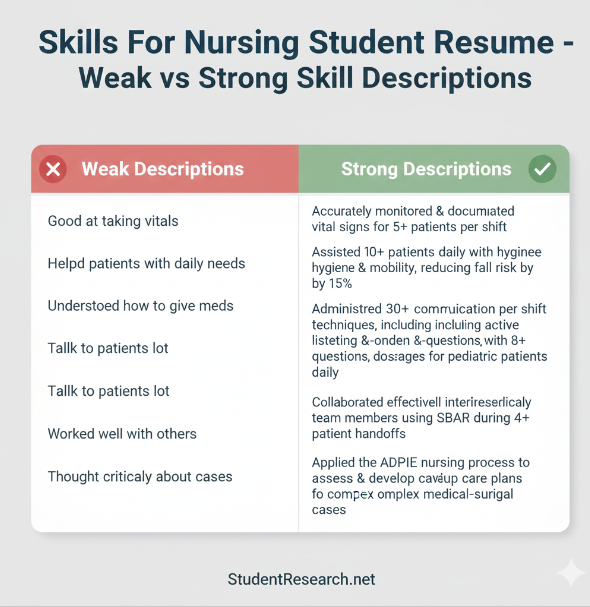
- Add Metrics: Mention the number of patients you managed during a typical clinical rotation
- Measurable Outcomes: Describe specific results, such as “reduced patient fall risk by implementing safety checks.
Final Statement: Your journey into nursing is just beginning, and with a well-optimized resume, you are ready to take the next step toward a rewarding career

