

Understanding Pharmacology Challenges: Why Gamification is Important
Pharmacology is notoriously one of the most difficult hurdles in nursing education due to the dense volume of drug classes and mechanisms students must internalize. Utilizing pharmacology games for nursing students transforms this overwhelming challenge into an interactive experience that promotes better clinical safety and memory retention.
What is the “Med-Surg” Mental Block?
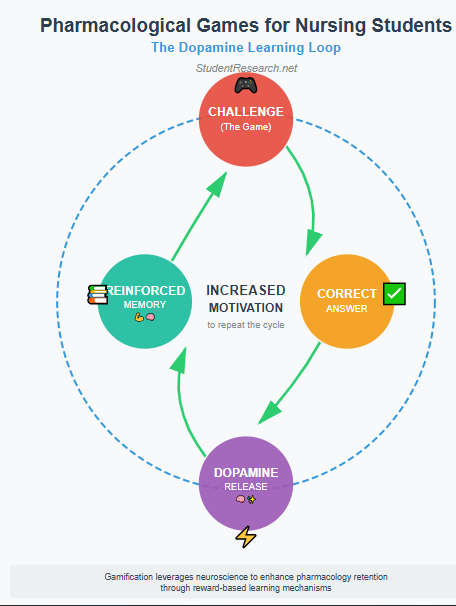
The “Med-Surg” mental block is a common phenomenon where nursing students feel paralyzed by the sheer volume of pharmacological data, leading to a breakdown in critical thinking during high-pressure clinical situations. This cognitive hurdle is best overcome by shifting the brain from a state of “information dread” to a state of “active engagement” through the Dopamine Learning Loop.
By using pharmacology games for nursing students, you can bypass this mental block and trigger a physiological response that makes learning feel effortless. Here is how the loop functions to keep you moving past the block:
Stage 4: The Motivation (Repeat Cycle): Because the game made you feel successful rather than overwhelmed, you are naturally motivated to repeat the cycle. This consistent repetition is what builds the “clinical muscle” needed to navigate complex Med-Surg scenarios at the bedside.
Stage 1: The Challenge (Anticipation): Instead of staring at a dry textbook, a game presents a specific mission, such as “Identify the Antidote.” This creates “productive stress,” which primes the brain to release dopamine as you anticipate solving the puzzle.
Stage 2: The Achievement (The “Aha!” Moment): When you correctly identify a drug class or solve a dosage math problem in the game, your brain’s reward center releases a burst of dopamine. This instant gratification shatters the mental block and replaces anxiety with a sense of mastery.
Stage 3: The Reinforcement (Memory Encoding): This chemical surge tells your hippocampus—the brain’s memory center—that this specific drug fact is important. The dopamine acts as a “save button,” moving drug interactions from temporary cramming into long-term clinical memory.
Reasons for high cognitive load and why rote memorization fails process-oriented learners:
- Information Density: Attempting to memorize thousands of contraindications without context leads to rapid cognitive fatigue.
- Lack of Visualization: Process-oriented learners struggle to see how a drug move through the body (pharmacokinetics) by just reading text.
- The “Silo” Effect: Rote memorization treats drugs as a list of facts rather than interacting components of a human biological system.
- Test Anxiety: High-stakes environments can cause a “freeze” response if the information hasn’t been practiced in a low-stress, active setting.
Benefits of Practice: The Power of Active Recall
Active recall is the process of pulling information out of your brain rather than trying to put it in. By incorporating pharmacology games for nursing students, you engage in a dynamic form of study that has proven physiological benefits for the learner.
Why gamification is important for nursing mastery:
Development of Critical Thinking: Most games require quick decision-making, which builds the “clinical muscle” needed for fast-paced nursing environments.Digital Guide to Pharmacology Games: Online and Interactive Tools
Dopamine-Driven Learning: Games trigger the brain’s reward system, making the repetitive nature of drug study feel rewarding rather than exhausting.
Enhanced Long-Term Retention: Forcing the brain to retrieve information during gameplay strengthens neural pathways more effectively than passive reading.
Safe Failure: Gamification allows students to see the consequences of a medication error in a virtual setting, providing a powerful “teachable moment” without patient risk.
Increased Student Engagement: Games break the monotony of traditional lectures, keeping students alert and motivated to participate in their own education.
In today’s tech-driven classrooms, digital pharmacology games offer a high-speed, interactive way to test knowledge. These platforms transform solitary study sessions into engaging, competitive experiences that mimic the fast-paced environment of a clinical floor.
How to Use Online Platforms for High-Stakes Learning
Online platforms allow for real-time feedback and repetitive practice, which is essential for mastering high-alert medication protocols.
#1 Pharmacology Game: Kahoot! – Competitive drills for drug-class mastery.
- Format: A live, quiz-style game where students answer multiple-choice questions on their mobile devices.
- Focus: Rapid identification of drug classifications, therapeutic effects, and contraindications.
- Why it Works: The competitive leaderboard encourages students to stay sharp and react quickly, mirroring the mental agility required during NCLEX exams.
#2 Pharmacology Game: Quizlet Live – Understanding pharmacokinetics through team matching.
- Format: A collaborative game that sorts students into random teams to match terms with their correct definitions.
- Focus: Mastery of complex pharmacokinetics terminology (e.g., half-life, first-pass effect).
- Why it Works: Since the correct answer is only on one team member’s screen, it forces communication and collective critical thinking.
#3 Pharmacology Game: Sporcle – Examples of fast-paced drills for the top 200 drugs.
- Format: Beat-the-clock “fill-in-the-blank” and “click-the-answer” quizzes.
- Focus: Memorizing the “Top 200” drugs, including their generic names and therapeutic categories.
- Why it Works: The high-pressure timer builds the speed and accuracy needed for safe medication administration.
Virtual Reality vs. Traditional Study: Immersive Simulations
While flashcards are great for definitions, immersive simulations are better for “steps to achieve” clinical competence.
#4 Pharmacology Game: Safe Medicate – Ways to master dosage calculations and patient safety.
- Format: A highly structured environment that simulates real-world dosage problems and intravenous (IV) infusions.
- Focus: Eliminating “math anxiety” by practicing complex pediatric and adult calculations.
- Why it Works: It uses a diagnostic model to identify exactly where a student’s numeracy skills are failing, allowing for targeted improvement.
#5 Pharmacology Game: vSim for Nursing – Steps to manage patient vitals during drug administration.
- Format: A 3D virtual patient environment where students must prioritize care and administer meds.
- Focus: Recognizing adverse reactions (like anaphylaxis) and adjusting care based on patient vital signs.
- Why it Works: Students learn the consequences of pharmacological errors in a risk-free environment, receiving a personalized performance score after each scenario.
Classroom Strategies: Types of Pharmacology Games for Groups
Group-based games are the backbone of nursing education because they foster teamwork—a critical clinical skill. These activities move learning beyond the screen and into a collaborative social environment.
Ways to Accomplish Goal: Turning the Classroom into a Clinical Floor
Educators can use these structured games to simulate the pressure and variety of a busy hospital shift.
#6 Pharmacology Game: Medication Jeopardy – Classification info based on body systems.
- Format: Traditional Jeopardy layout with categories like “Cardiac Killers” (Antihypertensives) or “Sweet Relief” (Insulins).
- Why it Works: It categorizes drugs by physiological effect, helping students organize their mental library.
- Gameplay Tip: Use increasing point values for harder questions, such as moving from generic names (100 pts) to rare adverse effects (500 pts).
#7 Pharmacology Game: Drug Class Bingo – Difference between brand names and generic names.
- Format: Students have Bingo cards with generic drug names. The “caller” reads out the brand name or a specific nursing indication.
- Why it Works: It forces students to bridge the gap between common commercial names and the technical names they’ll see on the NCLEX.
- URL: Use customizable generators like BuzzBuzzBingo to create themed cards.
#8 Pharmacology Game: Pharm Escape Room – Fixing issues in medication math to “unlock” the patient.
- Format: Teams must solve drug-related puzzles (dosage math, matching antidotes) to find “keys” to the next clue.
- Why it Works: It mimics the high-stakes pressure of a clinical emergency where finding the right medication information quickly is vital.
- Example Puzzle: A locked box requires a 4-digit code found by calculating the infusion rate of a Dopamine drip.
Practical Illustrations: Kinesthetic and Visual Learning
Not every student learns by reading; these games cater to those who need to see and move to understand.
#9 Pharmacology Game: Mechanism of Action (MOA) Charades – Why is [topic] important: Acting out cellular mechanisms.
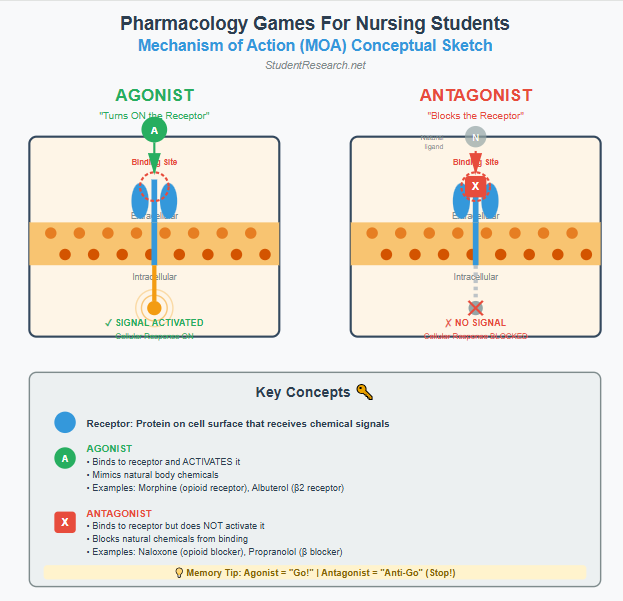
- Format: Students act out how a drug works (e.g., “blocking” a receptor or “carrying” an ion) without speaking.
- Why it Works: It simplifies complex pathophysiology into memorable physical movements.
- Common Prompt: Acting out a Calcium Channel Blocker by physically stopping others from entering a “cell door.”
#10 Pharmacology Game: “Who Am I?” – Using peer clues for conceptual clarity.
- Format: A sticky note with a drug name is placed on a student’s back. They must ask “Yes/No” questions to figure out which drug they are.
- Why it Works: It tests a student’s ability to describe drug properties (e.g., “Am I a diuretic?”, “Do I cause orange urine?”) accurately.
Learning Skills at Home: DIY and Solo Study Games
Mastery doesn’t just happen in the classroom. These solo-friendly activities allow students to “learn skill” sets at their own pace.
Guide to Gamifying the Solo Study Session
Self-study can be tedious, but these DIY methods keep the brain in “play mode.”
#11 Pharmacology Game: Drug-Side Effect Matching – Learn skill of identifying high-alert meds.
- DIY Method: Create a set of “Memory” cards. One card has the drug; the matching card has its most dangerous side effect (e.g., Warfarin and Hemorrhage).
- Benefit: Strengthens the association between a medication and the “priority assessment” a nurse must perform.
#12 Pharmacology Game: Scavenger Hunt – Identifying causes of “look-alike, sound-alike” (LASA) errors.
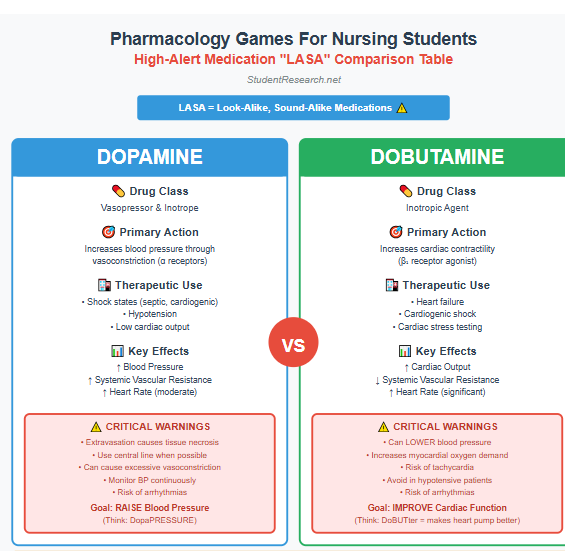
- DIY Method: Using your textbook or a drug guide, find 10 pairs of medications that look or sound similar (e.g., Dopamine vs. Dobutamine).
- Goal: Create a “warning sheet” for each pair to understand the distinct clinical causes of potential errors.
#13 Pharmacology Game: Crossword Pathophysiology – Linking disease processes to treatments.
- Format: Use free online tools to create crosswords where clues are symptoms and answers are the drug classes that treat them.
- Why it Works: It builds the “clinical reasoning” bridge between a patient’s diagnosis and their medication list.
Struggling to balance your budget and your grades? Get premium academic help without breaking the bank! StudentResearch.net offers affordable rates, seasonal promotions, and exclusive first-time discounts tailored for students. Quality research is now within your reach—save today!
Mobile Learning: Which App Option is Better?
For the student on the go, mobile apps provide rapid-fire education.
#14 Pharmacology Game: Nursing Central’s Grinder – Rapid-fire identification on the go.
- App Focus: This feature within Nursing Central provides flashcard-style drills with a focus on speed.
- Comparison: Better for pure memorization of facts than the scenario-based vSim.
#15 Pharmacology Game: Picmonic Playlists – Understanding [topic] via mnemonic image-conquering.
- App Focus: Uses “picture mnemonics” to turn drug facts into characters in a story.
- URL: Picmonic for Nursing
- Why it Works: Visual learners can “see” the side effects as part of a memorable image, making recall during exams significantly easier.
Conclusion
The journey through pharmacology is a marathon, not a sprint. By integrating these 15 games, you shift your brain from a state of passive “storage” to active “application.”Why is Pharmacology Importance Linked to Clinical Intuition?
Transitioning from basic memorization to bedside expertise.
A nurse who has “played” through scenarios is better prepared to recognize a bad drug reaction before it becomes fatal. Gamification builds the clinical intuition necessary to connect a patient’s lab values with their drug dosages, transforming you from a student into a safe, competent healthcare professional.
How Do I Start? Your Next Steps to Success
A tutorial-style summary on integrating one game per week into a study schedule.
- Week 1: Start with a digital drill like Kahoot! to find your knowledge gaps.
- Week 2: Introduce MOA Charades with a study group to master how drugs work.
- Week 3: Use Picmonic for the most difficult “look-alike” drugs. By rotating these methods, you ensure that pharmacology becomes a skill you own, rather than just a subject you studied.
Need more than just pharmacology help? From complex nursing dissertations and case studies to lab reports and expert editing, StudentResearch.net handles it all. Our comprehensive academic services ensure you excel in every subject. Partner with the experts today!

